
Aussie crypto casino 2026: what the paperwork says, not the banner
 Available in AU

Australia licenses online sports betting and lotteries. It does not license online casino games, and since 11 June 2024 the operators that do hold Australian licences have been legally forbidden from accepting digital currency at all. Read that twice. The only slice of Australian online gambling with a real licence behind it is the exact slice barred from touching crypto — which is why every crypto casino open to an Aussie punter sits offshore, under a Curaçao or Anjouan certificate, answering to a regulator in the Caribbean or the Indian Ocean.
That single fact reorganises the whole question. You are not choosing between a licensed local option and a risky foreign one, because the licensed local option does not exist for pokies and table games. You are choosing among offshore operators, and the only things you can actually compare are the ones written down: the licence number and whether it resolves in its register, the clause that governs identity checks and whether it prints an amount, the withdrawal ceiling and its clause, the deadline for supplying documents, and which coin comes back out. Bonus size is marketing. Game counts are marketing. The clause numbers are not.
Crypto casinos taking Aussie punters in 2026: the short version
Eleven operators are broken down below, ordered by how useful they are to somebody who wants to deposit crypto and get paid — not by brand size. Jack.com sits first because it has the fastest independently measured payouts and it publishes the conditions that could slow them down. Bitcasino.io sits second because it is the only site in the shortlist that prints an actual verification threshold in its terms. BC.Game, which several Australian-facing lists still rank number one, sits near the bottom with a bankruptcy ruling attached. Stake is included as the site you have heard of and cannot use.
| Operator | Licence and register status | Coins | Identity check trigger | Withdrawal cap | Payout speed |
|---|---|---|---|---|---|
| Jack.com | Curaçao OGL/2024/1562/1139, Active | 18+ | Deferred, no amount printed | $10,000 per 7 days, $20,000 per 30 days | 13 min measured average; SOL ~10, USDT-TRC20 ~12, BTC ~18 |
| Bitcasino.io | Curaçao OGL/2023/111/0069, Active, granted 1 July 2024 | 12 named plus SHIB | €2,500 or crypto equivalent, clause 6.6 | Up to 1,000,000 USDT per week on large requests | 3 confirmations required on deposits before withdrawal |
| Wild Fortune | Anjouan ALSI-202509073-FI2, Valid, expires 29 September 2026 | 10 via CoinsPaid | Before BTC play, clause 2.7; any withdrawal, clause 11.2 | A$1,500/day, A$7,500/week, A$22,500/month | Two weeks to supply documents or the withdrawal is cancelled |
| Metaspins | Curaçao OGL/2024/1063/0437, Active; terms print Anjouan instead | 9 named in bonus table | Unstated gambling threshold, clause 9.7 | Method-dependent, no figure printed | 30 days to answer a document request |
| Vave | Curaçao OGL/2024/1676/0905, Active, issued 19 May 2025 | 9 on a card on-ramp strip | Before any payout, no amount, clause 8.7 | 50,000 USDT or more paid in instalments over 30 days | ~5,000 USDT withdrawn in one documented test with no ID check |
| Wild Tokyo | Curaçao; one review cites pre-reform 8048/JAZ2019-049 | BTC, ETH, LTC plus PayID | Mandatory before any cash-out | Not published | Instant to under 15 minutes advertised |
| TrustDice | Curaçao, licence string inconsistently published | Faucet-funded plus major coins | No-KYC registration | Not published | Not independently measured |
| Bitsler | Curaçao OGL/2024/930/0387, Active, granted 22 July 2024 | Not published in text | Discretionary, any time, clauses 4.3 and 8.22 | Operator sets floor and ceiling per withdrawal, clause 8.6 | Pending and On Hold statuses, no deadline in terms |
| Thunderpick | Curaçao, Active | Not published in text | No moment named, clause 21.1 | €100,000 per week, clause 6.12 | Not published |
| BC.Game | Curaçao licence withdrawn ahead of revocation ruling; migrating to Anjouan | 100+ including Monero | No-KYC tier | Disputed; bankruptcy ruling 12 November | ~12 min average, BTC and LTC 15–35 min under load |
| Stake.com | Curaçao, in Anjouan migration | 8 commonly cited | Mandatory; first withdrawal flagged | Not applicable to AU | Under 30 min clean, plus 24–72 hours if flagged |
Which crypto casinos actually accept Australian players in 2026?
Bitcasino.io, Wild Fortune, Metaspins and Bitsler accept Australia in their own written terms. Jack.com and Thunderpick leave Australia off their restricted lists. Wild Tokyo, TrustDice and Vave are marketed to Australians but their country clauses are less clearly documented. Rocketpot and Wolfbet name Australia as restricted. Stake excludes it outright.

Why not one of these sites is licensed in Australia
The confusion here is almost always the same. People assume that because ACMA blocks gambling sites and the government talks about illegal offshore operators, playing at one must be an offence. It isn’t. The Interactive Gambling Act 2001 was written to bind the supplier, not the customer, and nothing in the twenty-five years of amendments since has changed that.
What the Interactive Gambling Act actually bans, and who it bans it for
The Act prohibits providing a “prohibited interactive gambling service” to a person physically present in Australia. Online casino games, online pokies and in-play sports betting all fall inside that definition. The offence and the civil penalties attach to whoever provides the service. An Australian who opens an account, sends a Bitcoin deposit and plays Gates of Olympus for six hours has committed no offence under the Act, has broken no state law by doing it, and will not be prosecuted for it.
What follows from that is less comforting than it sounds. Because the operator is the one breaking Australian law, the operator has every incentive to stay well outside Australian reach — no local entity, no local bank account, no local licence to lose. Which means the Australian legal system, which is not interested in punishing you, is also structurally unable to help you. There is no Australian regulator you can complain to that has any power over an Anjouan-licensed company. ACMA takes reports of illegal services and does something about the domain. It does not recover anybody’s balance.
The scale of that enforcement is worth knowing, because it tells you how the market behaves. Since ACMA issued its first blocking request in November 2019, 1,751 illegal gambling and affiliate websites have been blocked, and more than 230 services have withdrawn from the Australian market under regulatory pressure. The June 2026 round alone added twelve domains, including 7Signs, Chromabet, Donbet, Duospin, Freshbet, Slots Gem, Jacks Club and Lucky Start. An earlier round that year covered Frumzi, Great Win, MyStake (operated by Santeda International B.V.), Oh My Spins, RetroBet (Stable Tech N.V.) and Viperwin. None of those names appears in the shortlist above, and that is not a coincidence.
Is it illegal for an Australian to play at a crypto casino?
No. The Interactive Gambling Act 2001 makes it an offence to *provide* online casino games to someone in Australia. The prohibition binds the operator, not the player. Depositing crypto at an offshore casino is not a criminal act for you, and no Australian has been prosecuted for it. The consequences are practical, not legal.
The 2024 payment ban nobody mentions
Here is the part that every ranking page in the search results leaves out, and it is the load-bearing fact of the whole topic. The Interactive Gambling Amendment (Credit and Other Measures) Act 2023 passed on 6 December 2023 and commenced in full on 11 June 2024. It amended the Interactive Gambling Act to prohibit the use of credit cards, credit-related products and digital currency as payment methods for licensed interactive wagering services. Civil penalties apply to operators and to the payment providers that facilitate them. ACMA has reported industry compliance as high.
Sit with the consequence. Sportsbet, TAB, Ladbrokes and every other Australian-licensed wagering operator holds a genuine licence, integrates with the national self-exclusion register, sends you activity statements and answers to a regulator that can fine it. Those operators cannot accept your Bitcoin. Meanwhile every site that will happily take your Bitcoin holds no Australian licence, integrates with nothing, and answers to a regulator eleven thousand kilometres away. The regulation did not create a licensed crypto casino market with rules. It created a clean split: licensed and crypto-free, or crypto-friendly and unlicensed. Pick one.
That is also why you will never find an “ACMA-licensed crypto casino” no matter how many review pages promise one. There is no licence category to hold. A site claiming Australian licensing for casino games is either confused about the difference between a gambling licence and an AUSTRAC registration, or lying. AUSTRAC does register digital currency exchanges on its Digital Currency Exchange Register, and it does administer anti-money-laundering law. It does not license casinos, and a DCE registration gives a player precisely zero gaming recourse.
What ACMA blocking does and doesn’t do to your balance
Blocking is a direction to internet service providers, not a seizure. When ACMA blocks a domain, Australian ISPs stop resolving it, and the site becomes unreachable from a standard Australian connection. The company keeps operating. Your account keeps existing. Your balance keeps sitting in the operator’s hot wallet, on the other side of a door you can no longer open by typing the address.
In practice, blocked operators respond by launching mirror domains, and players find them within days. That is the cat-and-mouse game the 1,751 figure actually describes. But there is a version of this that goes badly: an operator that gets blocked, decides Australia is no longer worth the effort, and quietly closes the market. Then your balance is subject to whatever its terms say about jurisdictional withdrawal, which is usually not much. Keeping a large balance parked on any of these sites is the single most avoidable mistake in this entire topic. Deposit what you intend to play. Withdraw the rest.
What happens if ACMA blocks a casino while my money is still in the account?
Blocking stops Australian internet providers resolving the domain; it does not touch your funds or close your account. The operator keeps trading, usually on a mirror domain. The real risk is an operator deciding Australia is no longer worth serving and closing the market, leaving your balance governed by its own withdrawal terms.
The licensed alternative — and why it can’t help you here
Australian-licensed interactive wagering means sports betting, race betting and lotteries, licensed by state and territory regulators, with a set of consumer protections attached that offshore sites simply do not carry. BetStop, the National Self-Exclusion Register, launched in August 2023 under the National Consumer Protection Framework. One registration blocks you from every Australian-licensed online and phone wagering provider, for a period you choose between three months and life. Licensed operators must check it, must not open an account for an excluded person, and must not accept a bet from one. On top of that sit deposit limits, mandatory activity statements, restrictions on inducements to open an account, and a domestic complaints path that ends with a regulator holding a licence over the operator’s head.
None of that reaches a crypto casino. Not one clause of it. BetStop has no effect whatsoever on an offshore site, because there is no Australian licensee to bind — a distinction that matters enormously to anyone using self-exclusion as a genuine harm-reduction tool rather than a formality. Research published by the Australian Institute of Family Studies in November 2025 found only about one in three wagerers were even aware BetStop existed. Among the third who do know, some will assume it covers everything. It doesn’t.
So the trade is explicit, and worth naming rather than implying. Going offshore for crypto buys you product access — pokies, live tables, crash games, provably fair originals, coins the banks won’t touch — and it costs you every structural protection Australian regulation provides. Anyone selling crypto casinos as simply “faster casinos” is describing the deposit screen and skipping the contract.

How to read a crypto casino’s paperwork before you deposit
Reviews will tell you a site is “licensed and secure.” That phrase costs nothing to write. The check that actually means something takes about four minutes and needs no expertise, because both relevant regulators publish free, searchable registers, and the operator’s own terms are a public document sitting one click from the footer.
Six fields that are actually comparable
Across a dozen operators, only six things can be compared without translating one site’s marketing into another’s. First, the licence number and what its issuing register returns for it — holder, company number, grant date, status. Second, which domains the certificate names, which is not always the domain you typed. Third, the clause that governs identity checks, and specifically whether it prints an amount or leaves the trigger to discretion. Fourth, the withdrawal cap and the clause it lives in. Fifth, the deadline you get to supply documents, and what happens when it passes. Sixth, the payout coin rule.
Notice what is missing. Bonus size is not on that list, because at Vave, Metaspins and Bitsler the wagering multiple is not published on the promotions page at all — one of them hides it behind a terms tab that returns an empty page. You cannot compare a number that isn’t there. Game counts are not on the list either: Bitsler’s homepage advertises 7,000+ slots, which is a pokies count rather than a games total, and comparing it to a rival’s “8,000 games” figure compares two different quantities. Ratings out of five are not on the list because everybody’s scale measures something different.
Checking a licence number against its register
The Curaçao Gaming Authority runs a public certificate portal. Type the licence number and it returns the holder company, its registration number, the grant date, the current status, and the domains that certificate covers. The Anjouan Gaming Authority register does the same, adding issue and expiry dates. Both are free. Neither requires an account.
What that check catches is worth the four minutes. Vave’s certificate — OGL/2024/1676/0905, holder Latcas B.V., issued 19 May 2025, Active — names one domain: vavegame.com. A portal search for vave.com comes back empty. Those are not the same address, and the certificate covers one of them. Metaspins produces a different flavour of mismatch: the Curaçao portal shows OGL/2024/1063/0437 held by Metaspins N.V., company 160102, granted 4 October 2024, Active, naming metaspins.com. Its own terms, clause 1.1, print an Anjouan number instead — ALSI-202606048-FI2, for a company called 3-102-959384 SRL. Two records, two different companies, one website. Bitsler runs the inverse: the Curaçao portal reads Active for OGL/2024/930/0387, held by Oyine N.V., while the operator’s own clause 1.1 calls that same number an *application* under a transitional Certificate of Operation. The register is the issuer’s own record. Believe the register.
Then check the expiry, because these things run out. Wild Fortune’s Anjouan entry — ALSI-202509073-FI2, Metlait SRL, type b2c, issued 30 September 2025 — carries a 29 September 2026 expiry date. That is not a distant abstraction; it is a date to diary before depositing anything you would miss.
How do I check whether a crypto casino’s licence is real?
Find the licence number in the site’s footer or terms, then search it directly in the issuer’s public register — the Curaçao Gaming Authority portal or the Anjouan Gaming Authority register. Confirm four things: the status reads active or valid, the holder company matches the terms, the certificate names the exact domain you are using, and the expiry date has not passed.
The Curaçao-to-Anjouan migration, and why footer text goes stale
Something structural happened to offshore licensing in December 2024 and most Australian-facing review pages have not caught up with it. Curaçao’s new National Ordinance on Games of Chance — the LOK, enacted 20 December 2024 and in force from 24 December — abolished the master-and-sublicence model that had let a single holder cover dozens of brands. The Gaming Control Board became the Curaçao Gaming Authority. Every operator now needs its own licence, applied for and held directly, at real cost in time and money.
The result was an exodus. Roughly 850 operators have been re-papering their licences from Curaçao to Anjouan across 2024 to 2026, and most are mid-transition: paperwork filed, documents in process, footer still citing the old jurisdiction. BitStarz, BC.Game, Stake, mBit, Sportsbet.io, Bitcasino.io, Roobet, 7Bit, Cloudbet, Vave and Wild.io all appear on migration trackers as in-transition. Practically, that means the licence text at the bottom of a crypto casino in 2026 has an unusually high chance of describing an arrangement that no longer exists — Wild Tokyo is a good example, with one public review still citing 8048/JAZ2019-049, a pre-reform master-sublicence-era string that the LOK should long since have replaced with an operator-level OGL number.
One genuinely positive thing came out of the reform, and nobody in the search results mentions it. Under Article 5.3 of the LOK, the Curaçao Gaming Authority now requires licensees to give players free access to an independent alternative dispute resolution service. That is the first real complaints channel offshore players have ever had. Whether an operator names its ADR provider is now a legitimate thing to check before depositing — and most of them don’t.
The multi-brand pattern, and the illusion of switching
One more thing the registers give away. A single licence entry frequently covers a whole stable of brands. Metlait SRL’s Anjouan certificate spreads across 29 domains, with wildfortune.io among them. Novatrix SRL’s entry — ALSI-202508056-FI2, valid, issued 25 August 2025, running to 24 August 2027 — spans 66 domains, including both playamo.com and oshi.io. So PlayAmo and Oshi Casino are not two independent operators offering a choice. They are two storefronts answering to one holder.
Which turns a common instinct into a mistake. A player who has a bad experience — a stalled withdrawal, a bonus voided on a technicality, support that stops replying — closes the tab and signs up somewhere that looks completely different. Different name, different colours, different mascot. Same licensee, same compliance team, same clause library, same decision-maker on your dispute. Checking whether the new site sits on the same register entry as the old one takes one search and occasionally saves the entire exercise.
The operators, one by one
Order here follows usefulness to an Australian who wants to move crypto in, play, and get paid out — measured speed and printed rules at the top, discretionary rulebooks lower down, cautionary and unavailable cases last. Where a fact could not be verified in a public source, it says so rather than guessing.
Jack.com — the fastest measured payouts, and the only one publishing its triggers
Formerly Jackbit, renamed to Jack.com on 29 May 2026. Curaçao-licensed under OGL/2024/1562/1139, register status Active, supporting more than 18 cryptocurrencies. Australia does not appear on its restricted list. One migration tracker still files it as licence-pending, which is a discrepancy worth knowing about rather than resolving from the outside — the register and the tracker disagree, and the register is the issuer’s own record.
Independent testing clocked its average payout at 13 minutes, and that figure matters less than the fact that Jack publishes a per-asset breakdown you can check it against: Solana around 10 minutes, USDT on TRC-20 around 12, Bitcoin around 18. Its terms allow up to 24 hours; standard withdrawals rarely use a fraction of that. Identity verification is deferred, with no threshold amount printed in the clause — the one soft spot in an otherwise unusually transparent operation. Caps sit at $10,000 per rolling seven days and $20,000 per 30 days, which is modest by the standards of this list and perfectly adequate for anyone who is not planning to hit a jackpot.
What earns it the top spot is not the speed number. It is that Jack publishes no-verification thresholds and per-chain timing data rather than a bare “instant withdrawals” banner, which means a player has something to hold it to. Every other site in this shortlist advertises speed; this is the only one that hands you the conditions under which its own claim fails.
Bitcasino.io — the only operator that prints a number
Operating since 2014, run by Moon Technologies B.V. (company 152185). The Curaçao Gaming Authority portal returns OGL/2023/111/0069, granted 1 July 2024, status Active, and the certificate names bitcasino.io — the domain you actually type, which is rarer than it should be. Its own general terms accept Australia; clause 1 names Japan as restricted and defers the full list elsewhere. An older string, 1668/JAZ, still sits on an AML page dated 24 November 2022, which is untidy rather than alarming.
Then comes the clause that makes this site worth more than any welcome package on this page. Clause 6.6: extra identity checks may apply to any withdrawal above €2,500 or its crypto equivalent. That is the only printed verification threshold found anywhere in this shortlist. Everywhere else the trigger is “at our discretion” or “at a certain threshold” with the amount conveniently omitted. Here you know the number, which means you can plan around it. The same clause reserves checks below that figure, and clause 3.13 permits random Account Health Checks with no suspicion required at all — deposits paused, play continuing. Deposits need 3 blockchain confirmations before they can be withdrawn (clause 6.1). Large requests are paid at up to 1,000,000 USDT per week until settled, with “large” left undefined (clause 6.10). Clause 6.4 reserves one full turnover of your deposits before a withdrawal is accepted, and clause 6.8 lifts that to 5x where the operator suspects a mixer was involved.
Two traps deserve flagging. No document deadline appears anywhere — not in the terms, not in the AML policy, not in the help centre — so once a check starts there is no contractual clock on it. And clause 5 voids deposits below a per-coin minimum: neither credited nor returned. Minimums include 0.25 USDT, 0.002 LTC, 3 TRX and 10,000 SHIB, they apply per single transaction, and smaller deposits are not summed. Sending a test dribble to see if the address works is a way to lose it.
The welcome package reaches 5,000 USDT across three deposits — 100% to 1,500 USDT, then 50% to 2,000 USDT, then 100% to 1,500 USDT. Wagering is 30x inside seven days, minimum qualifying deposit 50 USDT in one transaction, maximum bet 4 USDT while the bonus is live, pokies count 100% and live dealer 10%, and your deposit stays locked until the turnover is done. Twelve coins are named in the help centre — USDT, USDC, BTC, ETH, TON, TRX, LTC, XRP, BNB, ADA, DOGE, MATIC — with SHIB appearing as a thirteenth in the deposit-limits table.
Wild Fortune — caps printed in Australian dollars, licence expiring soon
Operated by Metlait SRL under Anjouan licence ALSI-202509073-FI2, type b2c, issued 30 September 2025, status Valid. That certificate spreads across 29 brand domains, wildfortune.io among them. Clause 1.1 of the terms cites a second number, Tobique 0000064, which has not been independently verified here. The terms accept Australia outright — clause 2.4 lists 50 barred territories and Australia is not one of them.
The reason it ranks this high is clause 11.8, which does something no other operator in this shortlist bothers with: it prints its withdrawal ceilings in Australian dollars. A$1,500 a day, A$7,500 across a rolling seven days, A$22,500 a calendar month, resetting on the 1st. Progressive jackpot wins sit outside those limits and are paid in full. A winning balance above the monthly ceiling gets paid in monthly instalments of up to that sum. Minimum withdrawal is A$30 (clause 11.1), a bank intermediary may take up to €16 (clause 11.11), and clause 9.7 requires each deposit to be turned over 3x before you can withdraw it.
The catches are real and specific. Clause 2.7 requires a passport or driver’s licence before you play with BTC at all, with deposits and bets blocked until the check clears — so the “no KYC” framing does not apply here for Bitcoin players. Clause 11.2 lets the operator verify any withdrawal with no amount attached. Clauses 8.4 and 9.3 give you two weeks from the withdrawal request to supply documents, after which the account is locked, the withdrawal cancelled, and under 9.3 the account terminated with funds confiscated. And clause 11.15 forfeits winnings above C$7,500 arising from your first three deposits, bonus or not, though your own deposited funds stay withdrawable. The bonus page served a Canadian locale when read — 225% up to C$7,500 plus 250 free spins across five deposits — with “0x wagering” attached only to the spins and the cash-match multiple sitting behind a terms tab that returned nothing. Ten coins run through CoinsPaid: USDT, BTC, ETH, XRP, BNB, TRX, ADA, LTC, BCH and DOGE. The 29 September 2026 licence expiry is the first thing to re-check.
Metaspins — pays out in the coin you sent, and lists two different licences
The Curaçao Gaming Authority portal returns OGL/2024/1063/0437 for holder Metaspins N.V., company 160102, granted 4 October 2024, Active, with metaspins.com as the single domain on the certificate. The operator’s own clause 1.1 and footer print something else entirely: Anjouan licence ALSI-202606048-FI2, for a company called 3-102-959384 SRL. Two records naming two different companies for one website. Its terms accept Australia.
Clause 11.3 is the one to internalise before you deposit anything: you withdraw in the same coin you deposited. That turns the exit route into a decision you make at the start rather than the end. Deposit in something an Australian exchange actually lists and the round trip back to dollars is trivial. Deposit in something obscure because the deposit bonus looked better and you will discover the awkward part at cash-out. Clause 12.2 routes withdrawals back through the deposit method generally; 11.3 makes it specific for crypto.
Verification sits at “a certain threshold” under clause 9.7, with the amount left out — age is always verified, identity once your play reaches an unstated level, and the operator keeps discretion to verify at any time and lock the account until it has. Clause 9.10 gives you 30 days to comply or at least acknowledge the request, which is the most generous window in this shortlist; miss it and the account can be suspended or closed, withdrawals held, and any remaining balance confiscated. Clause 9.9 confiscates winnings and bonuses where account details fail to match, with the deposit possibly returned. Clause 12.5 reserves a cap “limited by payment method” without printing a figure and allows monthly instalments. The homepage advertises 0% withdrawal fees while clause 12.2 says charges may apply depending on method — both are the operator’s own words, and only one of them is in the contract. Clause 13.1 charges US$10 a year on a dormant account after 12 months.
Bonus terms are worth reading closely because the weighting is unusual. The first deposit offers 100% up to 1 BTC with the wagering multiple unstated and the dedicated bonus page redirecting to the homepage. Clause 14.11 caps bets at 5 USDT per spin or round while a bonus runs. Clause 14.13.1 weights pokies at 100% and live casino, table games, crash titles and the site’s own originals at 0% — meaning the games Metaspins is built around contribute nothing at all toward clearing its bonus. Nine coins appear in clause 14.12, but as a bonus-minimum table, not a deposit list; no coin total is published anywhere.

Vave — check the address bar against the certificate
Latcas B.V., live since 2022, holding Curaçao licence OGL/2024/1676/0905, issued 19 May 2025, status Active on the portal. And here is the thing to look at twice: that certificate names vavegame.com, one domain, and a portal search for vave.com returns empty. If the address in your browser is not the address on the certificate, the licence you are relying on does not describe the site you are using. It is the cleanest example of a mismatch that a four-minute register check catches and a five-star review does not. Australian acceptance is a further open question — the country clause was outside the sections publicly documented, so its acceptance of Australian players rests on marketing rather than on a read of its own terms.
Verification runs under clause 8.7: reserved before any payout, with no amount printed, and pending withdrawals can be held or cancelled during the check. The document list is unusually specific — a selfie holding your ID, a second selfie beside a sheet bearing the site name and that day’s date, a phone call, and in some cases video. You get 14 days from the first request. Against that, one documented real-money test saw roughly 5,000 USDT withdrawn cumulatively with no identity check at any point, which tells you the clause is discretionary rather than automatic. It also tells you nothing about what happens on the day they decide to use it.
Clause 8.8 pays wins of 50,000 USDT or more in equal instalments across up to 30 days, and clause 8.1 splits anything above a payment system’s own limit. Clause 8.11 wants 3x turnover on your deposit in casino or live casino before a withdrawal, 1x on sports. Named costs: up to 16 USDT for a bank intermediary (8.6) and €12.50 on a transfer at account closure (8.10). The welcome package runs over four deposits — 150% to 1.5 BTC plus 100 free spins, then 100% to 1 BTC, 50% to 1 BTC, 25% to 0.5 BTC — with the wagering factor missing from the promotions page entirely. VIP level 1 unlocks weekly cashback up to 7% of net losses. The loyalty scheme is worth doing the arithmetic on: one point per US$30 wagered on pokies, table and live dealer excluded, and 200 points redeem for US$1. That is US$6,000 of turnover for a single dollar back. The “VIP” programme here is a cheap motel with a fresh coat of paint.
Wild Tokyo — the fiat hybrid, with a licence string worth checking
Launched around 2020 to 2021, styled as Japanese cyberpunk, and squarely aimed at Australian players — AUD display, PayID alongside crypto, 8,000-plus games. Ownership is where it gets murky: one public review attributes it to Altacore N.V., another to GBL Solutions N.V., which also stands behind Rolling Slots. Two credible sources, two different companies. That inconsistency is itself the finding, and it is not resolvable from outside the register.
The licence needs the same treatment. One review cites 8048/JAZ2019-049 — a pre-reform master-sublicence-era string of exactly the kind the December 2024 LOK was written to abolish. If that is still what the footer says, it describes an arrangement that no longer legally exists, and the operator-level OGL number that should have replaced it needs looking up before you deposit. Welcome offers are quoted between 250% and 260% up to AU$5,300 with 600 to 620 free spins depending which page you land on, and the fact that the figure moves by page and locale tells you something about how firmly any of it is nailed down.
Where it genuinely earns a place is the payment model. Bitcoin, Ethereum and Litecoin sit next to PayID, with no withdrawal fees and cash-outs advertised from instant to under 15 minutes — repeatedly named across Australian fast-payout lists for exactly that. For a player who wants crypto speed without holding coins as an asset, that hybrid works. Two caveats come with it. Its own material states that mandatory identity checks run before any cash-out, so nobody should arrive here expecting anonymity. And the PayID leg means an Australian bank and an AUSTRAC-regulated rail are unavoidably in the picture, which for some players is the point and for others defeats it.
TrustDice — the faucet, and a genuine no-deposit route
Operating since 2018, associated with Satoshi Gaming Group N.V., Curaçao-licensed. Public sources agree on the jurisdiction and disagree on the exact licence string, so the register lookup is on you before depositing — recorded here as a genuine limitation rather than smoothed over. Clause-level detail is thinner in public sources for this operator than for the sites whose terms have been read line by line, and that gap is worth weighing.
The product is crypto-native rather than a fiat casino with a wallet bolted on. A free BTC faucet hands you a working balance without a deposit, which makes it the only site in this shortlist where a curious player can look around with actual funds and no money at risk. Provably fair in-house originals, a native TXT token with staking rewards, no-KYC registration, 8,000-plus games, and a sportsbook covering 35-plus sports with real esports depth and in-play markets. The advertised welcome package reaches 3 BTC across three deposits, which is a headline number rather than a plan.
The faucet deserves precise framing, because it is the honest answer to a whole category of search. It is not a bonus. There is no deposit to unlock it, no wagering multiple attached to the faucet balance itself, and no expectation that you will convert. It is small — deliberately, it is a sampler. What it buys you is the ability to test the lobby, the game speed, the interface and the support desk before any of your own crypto moves. Doing that first, at every site you are considering, is worth more than any welcome match on this page.
Are crypto casino no-deposit bonuses worth claiming?
Rarely, on the numbers. A typical A$10 to A$30 no-deposit credit carries 40x to 50x wagering, so A$20 free means roughly A$800 to A$1,000 of turnover before a cent is withdrawable. Faucets are the better version — small, genuinely free, and no turnover attached. Treat both as a demo, not income.
Bitsler — ten years running, and the most discretionary rulebook here
On the web since 2015 by its own homepage, which makes it the longest continuous operation in this shortlist — worth something in a sector where brands appear and vanish inside eighteen months. Oyine N.V., company 144430. The Curaçao portal returns OGL/2024/930/0387, granted 22 July 2024, Active, with the domain matching bitsler.com. Its own clause 1.1 describes that identical number as an application held under a transitional Certificate of Operation. Register says Active, operator says pending. Its terms accept Australia, and clause 8.2 warns that the coins on offer may differ by jurisdiction — no coin list appears in plain text anywhere: the footer renders as unlabelled icons and the cashier sits behind a login.
The verification wording is where this site earns its ranking. Clause 4.3 permits proof of age and identity to confirm registration details or meet anti-money-laundering rules. Clause 8.22 adds source-of-funds or source-of-wealth documents at any time — for instance when deposits run large or your spending concerns the operator. Neither clause prints an amount. No deadline for supplying documents appears in the terms or the help centre. Clause 4.4 suspends the account until the requested information arrives. Verification runs through Veriff: both sides of your ID photographed inside a recorded video session, then a selfie, sometimes a proof of address dated within three months and shown with all four corners visible. The help centre documents two hold statuses — Pending for a manual check, On Hold for suspected unusual activity.
Then clause 8.13, which is the one nobody expects. A large withdrawal may be paid in instalments and/or in BTC, ETH or USDT at the operator’s discretion, regardless of what you deposited. Send DOGE, get paid USDT. Anyone whose plan depends on holding a particular coin needs to price that in before the first deposit. Clause 8.6 lets Bitsler assign its own floor and ceiling to each withdrawal, revealed when you make the transaction, with no figures in the terms at all (the help centre gives a minimum around $10). Clauses 8.13 and 10.5 require at least one full turnover of each deposit. The first-deposit offer is a choice: 100% to $1,000 credited to your balance immediately, or 200% to $2,000 released in tranches as XP accumulates, both with 500 free cash spins — and the page prints dollar signs without naming which dollar, while the wagering multiple hides behind a closed toggle. The 7,000+ figure on the homepage counts pokies, not games.
Thunderpick — the highest ceiling, the vaguest verification
Curaçao-licensed, register Active, Australia absent from its restricted list. The product’s centre of gravity is esports and sports betting with a casino attached, which makes it a materially different proposition from the pokies-first sites around it — worth knowing if you came here for reels and worth a look if you didn’t. Coin list and sign-up fields are not published in plain text on the pages read.
Two numbers define it, pulling in opposite directions. Clause 6.12 sets a €100,000 weekly withdrawal ceiling — by a wide margin the highest published cap in this shortlist, and the single most relevant figure on the page for anyone whose concern is a large win rather than a Saturday session. Against that, clause 21.1 governs verification while naming no moment at which a check occurs. Not a deferred check, not a threshold check. No stated trigger at all, and no amount printed. That is the weakest verification wording found across every operator examined here.
Which produces an odd risk profile. The ceiling says the operator is set up to pay serious money. The verification clause says it can start asking questions at any point it chooses, with nothing in writing about when or why. For a large win those two facts collide precisely when it matters most, and the contract gives you nothing to point at.
BC.Game — the widest coin list and the worst paperwork
The product is genuinely class-leading. Live since 2017, one of the largest crypto casinos by traffic anywhere, 100-plus cryptocurrencies including Monero, in-house hash-based provably fair originals, 5,000-plus pokies, a no-KYC tier, and a 300% welcome package advertised up to AU$20,000 on Australian-facing pages. Payouts average around 12 minutes, with BTC and LTC stretching to 15 to 35 minutes under heavier network load — genuinely fast, and mostly attributable to chain conditions rather than internal holds.
Now the part that several Australian-facing lists still ranking it number one manage not to mention. On 12 November the Joint Court of Justice of Aruba, Curaçao, Sint Maarten and the BES Islands declared BC.Game bankrupt. The claims were lodged in October 2024 by the Foundation for the Representation of Victims of Online Gaming (SBGOK), a non-profit formed on 25 March 2019 that has previously pursued 1xBet’s 1xCorp and Usoftgaming, and was involved in the bankruptcy of former master licence holder Cyberluck. Claims tied to Small House BV — which acquired BC.Game in February 2024 from Blockdance BV, the prior operator, which handed over operations that April — exceed $2 million; independent trackers put unpaid claims above $2.1 million. Small House argued liabilities from earlier operations were not part of the deal. The court found both entities had failed to meet their financial obligations.
Then the licence. The Curaçao regulator signalled that it would revoke the licence of Small House BV over those disputed former-player claims, and BC.Game withdrew its Curaçao licence ahead of the regulator’s ruling — a licence it had only obtained under the LOK framework in April 2024. It is now in transition toward Anjouan. On 21 November the operator said it would appeal, called the judgment “erroneous”, said it would “spare no expenses” challenging it, and characterised the allegations as lacking sufficient supporting evidence. Separately, the Dutch Gambling Authority fined Blockdance €840,000 in October for unlicensed services, and Australian regulators issued warnings over the company’s market activity back in 2022.
So the honest position: best coin support in the market, strongest provably fair implementation, fast payouts for ordinary play, and a court-confirmed record of not paying players who won more than ordinary amounts. For a modest recreational session it will very likely pay you. For anything you would be upset to lose, the paperwork is a warning and it is a recent one.
Stake — the one you have heard of, and cannot use
Live since 2017, the highest-volume crypto casino and sportsbook on the planet, casino and betting on a single wallet, Curaçao-licensed and currently in the Anjouan migration. It is also not available to Australian players. Stake blocks Australia along with the United States, the United Kingdom, Ontario and several EU member states, and multiple independent reviews state plainly that signing up from here is not an option. That is Stake’s own commercial decision about regulated and enforcement-heavy markets, not an Australian prohibition on you.
Its payout behaviour is instructive anyway, because it shows how wide “instant” can stretch. The terms promise crypto withdrawals within 24 hours. Stake’s own help centre then notes that a first withdrawal, or a flagged account, can add a further 24 to 72 hours of review on top of that. A clean verified account with nothing tripping a review can see funds in under 30 minutes. So both “under half an hour” and “three days” are true statements about the same site, and which one you get depends on an account status you cannot see in advance. That advertised 0-to-2-day window is not a worst case; it is the range the compliance process is built to produce.
The workaround people reach for is a VPN, and the risk there is worth stating precisely because it is usually described wrongly. You are not risking prosecution — no Australian law makes accessing a gambling site an offence. You are risking your balance. Geo-circumvention breaches the operator’s own terms, and the standard remedy across this entire sector is account closure with confiscation of winnings. Deposits may come back. Winnings generally do not. Getting your account closed at the exact moment you have something worth withdrawing is the least satisfying way to learn where a site’s restricted-countries list actually bites.

Payout speed: what the blockchain owes you and what the operator owes you
Every crypto casino homepage says the same three words. Instant. Fast. Minutes. Then the actual published averages land between 10 and 18 minutes, and nobody explains the gap — which is a shame, because the gap is the most useful thing on the page.
Where the ten minutes actually go
Start with what the chains physically require. Solana finalises a transaction in roughly one second. USDT on TRC-20 settles in about three seconds, with a transfer arriving inside one to three minutes end to end. XRP clears in three to ten seconds. Ethereum runs 12-second blocks and reaches hard finality in about 13 minutes. Litecoin takes 5 to 30 minutes. Bitcoin needs roughly 10 minutes per block, which puts a realistic end-to-end transfer somewhere between 10 and 60 minutes depending on fee market and confirmation requirements.
Now hold those numbers against the operator averages. Jack.com publishes Solana at around 10 minutes. Solana finalises in one second. So roughly 599 of those 600 seconds are not the blockchain. They are the operator: batching withdrawal requests into groups, running risk scoring, sweeping the hot wallet, waiting for whatever automated review sits between “approved” and “broadcast”. The same arithmetic run on Bitcoin gives the opposite result — an 18-minute Bitcoin average is mostly honest physics, because a single confirmation eats ten of those minutes on its own. Which reframes the whole comparison. Bitcoin’s slow number is the chain. Solana’s slow number is policy. When an operator’s fast-chain average sits in double-digit minutes, that is a disclosure about its internal processes, not about Solana.
Compliance review then sits on top of the baseline, and it is a different order of magnitude. A manual or semi-automated hold can run as long as the operator wants, without any advance disclosure of why. Bitsler’s help centre names two hold statuses — Pending for a manual check, On Hold for suspected unusual activity — and nothing in its terms puts a clock on either. Stake’s own help centre adds 24 to 72 hours for a first withdrawal or a flagged account, on top of the 24 hours already in its terms. The UK Gambling Commission, which publishes complaint data that offshore regulators do not, reports that withdrawal delay is the single most common subject of player complaints it receives — roughly 2,000 a year. The technology solved transfer speed years ago. The queue moved to compliance, and compliance does not appear in a homepage banner.
Do crypto casinos really pay out instantly, or is that marketing?
Mostly marketing. Solana finalises in about a second and TRON in three, yet published operator averages sit at 10 to 18 minutes — that difference is internal batching and risk review, not the blockchain. A clean, verified, modest withdrawal often does land in minutes. A first withdrawal or a flagged account can take days.
Withdrawal caps, instalment clauses and the fine print on a big win
Speed is the question people ask. Ceilings are the question that matters if things go well. And the numbers vary by more than an order of magnitude across this shortlist, which is not something any comparison table in the search results reflects.
At the top, Thunderpick’s clause 6.12 allows €100,000 per week. Bitcasino.io’s clause 6.10 pays large requests at up to 1,000,000 USDT per week until settled, leaving “large” undefined — generous in effect, vague in wording. Jack.com caps at $10,000 per seven days and $20,000 per 30 days. Wild Fortune prints A$1,500 a day, A$7,500 a rolling week and A$22,500 a calendar month, with progressive jackpots exempt and paid in full. Metaspins declines to print a figure at all, reserving a cap “limited by payment method” under clause 12.5. Bitsler goes further and assigns a floor and ceiling per withdrawal, revealed only when you make the transaction.
Instalment clauses are the sibling nobody reads. Vave’s clause 8.8 pays any win of 50,000 USDT or more in equal parts across up to 30 days. Wild Fortune pays a balance above its monthly ceiling in monthly instalments. Bitsler’s clause 8.13 pays large withdrawals in instalments and, at its discretion, in BTC, ETH or USDT regardless of what you deposited. None of that is unusual or sinister in itself — it is how operators manage liquidity — but it means a genuinely large win is not a single transaction. It is a schedule, spread over weeks, during which the operator continues to hold your money and can continue to ask you questions about it.
The deposit-turnover rule that catches everyone
Here is the clause that trips more first-timers than any bonus condition, and it has nothing to do with bonuses. Almost every operator here requires your deposit to be wagered before it can be withdrawn, whether or not you touched a promotion.
Vave’s clause 8.11 wants 3x in casino or live casino, 1x on sports. Wild Fortune’s clause 9.7 wants 3x. Bitcasino.io’s clause 6.4 reserves 1x, and clause 6.8 lifts it to 5x where mixer use is suspected. Metaspins clause 4.2 wants at least 1x on deposits, rewards and NFT revenue share alike. Bitsler’s clauses 8.13 and 10.5 want at least one full turnover. So a player who deposits 500 USDT, thinks better of it and immediately requests a withdrawal gets refused at every single one of these sites — at Vave and Wild Fortune they would need to put 1,500 USDT through the pokies first. The stated reason is anti-money-laundering: a casino cashier is not a currency-conversion service. The practical effect is that the money you deposit is committed to being gambled, and the house edge gets its bite regardless of what you originally intended.
Which coin to use, and what the wrong one costs
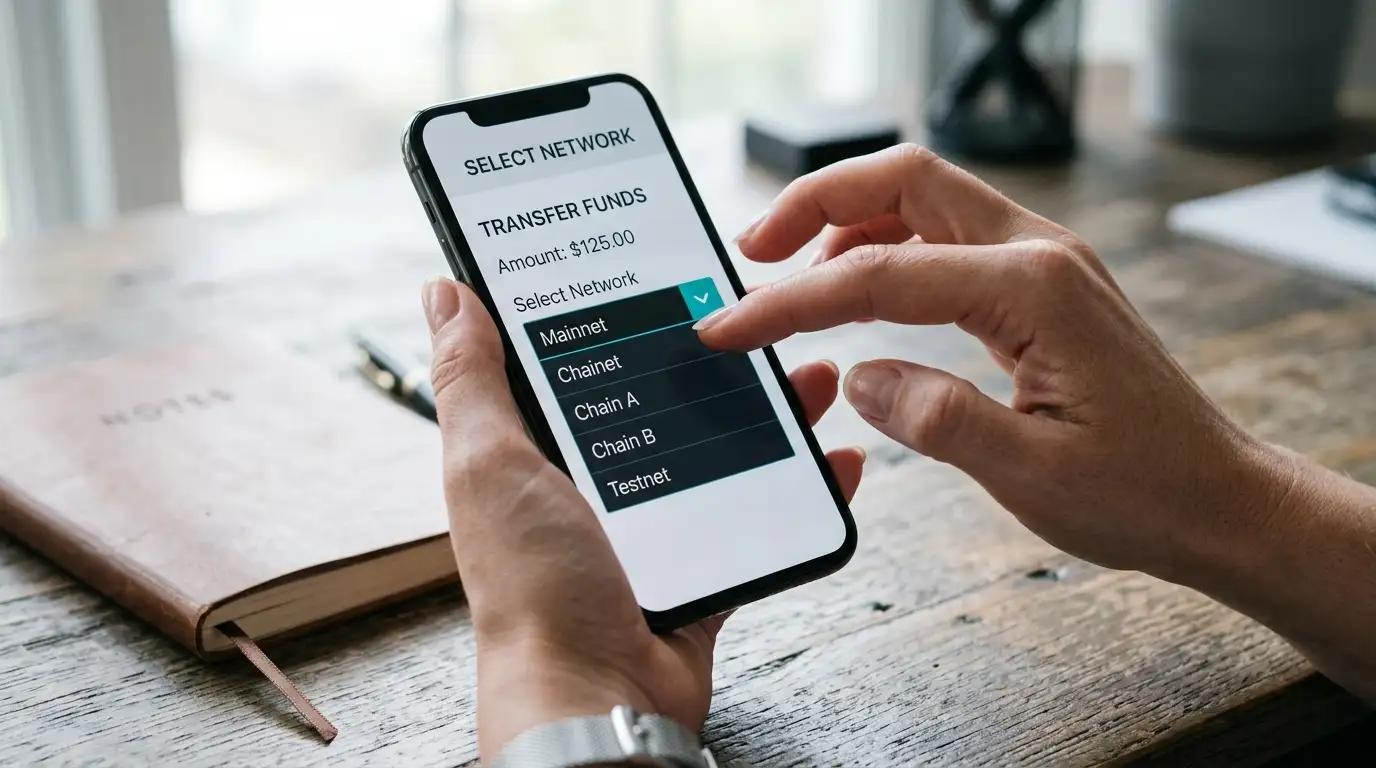
This is the one decision entirely within your control that measurably changes how much money arrives, and every page in the search results treats it as a feature list. “Accepts BTC, ETH, LTC, USDT and DOGE.” Fine. What does each one cost?
| Network | Typical USDT fee | Settlement or finality | Typical exchange withdrawal fee | Practical note for casino use |
|---|---|---|---|---|
| Solana (SPL) | Under $0.001 | About 1 second | $0.10 on Binance | Cheapest and fastest combination available; SPL-only addresses |
| Tron (TRC-20) | $0 with rented energy, about $1 without | About 3 seconds | $1.00 on Binance, $0.80 on OKX | The sector default; a transfer burns ~65,000 energy and 345 bandwidth |
| Polygon (PoS) | About $0.001 | ~2 sec soft, ~3 min hard | $1.00 on Binance | Cheap on-chain, but the exchange fee dominates |
| TON | About $0.005 | About 5 seconds | Varies | TON-only addresses; supported by fewer cashiers |
| Base | About $0.05 | About 2 seconds | $0.10 on Binance | EVM addresses; low all-in cost off an exchange |
| Arbitrum One | About $0.10 | About 1 second soft | $0.10 on Binance | Same as Base in practice |
| BNB Chain (BEP-20) | About $0.10 | About 3 seconds | $0.29 on Binance | Widely supported, middling cost |
| Litecoin | Fractions of a cent | 5 to 30 minutes | Varies | Native coin, no token confusion; slower than the fast chains |
| Bitcoin | Varies with demand | 10 to 60 minutes | Varies | Slowest and most fee-volatile; still the most universally accepted |
| Ethereum (ERC-20) | $2 to $10 | ~12 sec blocks, ~13 min finality | $5.00 on Binance, $1.40–$4 on OKX | Avoid for anything under $1,000 |
The nine networks and what a transfer costs on each
Tether circulates roughly $189.5 billion across more than a dozen networks, and TRON alone carries over $86 billion of TRC-20 USDT — which is why TRC-20 became the default rail at crypto cashiers. But the same token on a different network is a different economic proposition, and the spread is not subtle.
Run the numbers on a $50 movement, which is a realistic recreational deposit. On Solana, $50 in and about $49.999 out. On Polygon, near-identical. On TON, roughly $49.995. On Tron, exactly $50.00 if your wallet has staked TRX for energy and bandwidth, or about $49 if it hasn’t and the network burns TRX to cover the gap. On Base about $49.95, on BNB Chain and Arbitrum about $49.90. On Ethereum: $40 to $48 out. A $10 fee on a $50 transfer is a 20% haircut — larger than any welcome bonus on this page survives once its wagering requirement is applied. That is why Ethereum mainnet stopped making sense for retail-sized USDT movements years ago, and it is why the “accepts ETH” line on a casino homepage is not the endorsement it looks like.
The exchange leg then adds a fee that usually exceeds the network cost, and the exchange keeps the spread. Binance charges $0.10 to withdraw USDT on Solana, Arbitrum, Optimism and Base; $0.29 on BNB Chain; $1.00 on TRON and on Polygon; $5.00 on Ethereum. OKX runs $0.80 on TRON and $1.40 to $4 on Ethereum. For small transfers, the exchange fee is the entire economic story — pulling $50 off Binance costs you 0.2% on Solana and 10% on Ethereum, for a transaction the two chains perform identically from your point of view.
One rule sits above all the pricing: the network must match on both sides. USDT on TRON and USDT on Ethereum are separate token contracts on separate ledgers. Sending TRC-20 USDT to an ERC-20 address destroys the funds — no support ticket recovers that. Coinbase historically credited only ERC-20 USDT, not TRC-20. Copy the deposit address from the cashier, confirm the network label matches your withdrawal screen, and send a normal amount rather than a test dribble, for reasons the next part explains.
Deposit minimums: the clause that eats small deposits
Bitcasino.io’s clause 5 is the one to read before you send anything. Minimums apply per single transaction, smaller deposits are not summed, and anything below the minimum is void — neither credited nor returned. The per-coin table includes 0.25 USDT, 0.002 LTC, 3 TRX and 10,000 SHIB. So the sensible-sounding instinct of sending a few cents first to check the address works is, at that cashier, a way to donate a few cents and learn nothing.
Wild Fortune has the untidier version of the same problem: its banking page lists per-coin minimums such as 0.0001 BTC, which sit well below the €20 minimum in its own clause 10.4, and the operator leaves the two figures unreconciled. Which one binds you is not stated. When two numbers in the same rulebook disagree, assume the one less favourable to you is the one that gets applied at the moment it matters.
Getting back to Australian dollars
The exit route deserves planning before the entry, and two clauses make that concrete. Metaspins clause 11.3 pays you out in the coin you deposited — so if the plan is to sell back to AUD on an Australian exchange, deposit in a coin that exchange lists, or the round trip acquires an extra conversion and an extra spread. Bitsler clause 8.13 does the opposite and arguably worse: a large withdrawal may come back in BTC, ETH or USDT at the operator’s discretion, whatever went in. Either way, the coin you receive is not necessarily the coin you chose, and the difference is priced in exchange spreads and network fees you pay on the way home.
Then there is the leg most players forget entirely. An Australian exchange is an AUSTRAC-regulated business, registered on the Digital Currency Exchange Register, and the crypto travel rule that took effect on 1 July requires locally regulated exchanges to collect additional information about senders and recipients on transfers. The AML/CTF Amendment Act passed on 29 November 2024 broadens AUSTRAC’s scope further, with a three-year transition for customer due diligence by existing reporting entities running from 31 March 2026 to 30 March 2029. Which means the casino leg of your money’s journey may be anonymous while the exchange leg is documented at both ends. Anyone treating crypto casinos as a privacy tool should understand where that privacy actually stops.
Which cryptocurrency is cheapest and fastest for casino deposits and withdrawals?
USDT on Solana, at under $0.001 in network fees and about one second to finality. USDT on Tron is the sector default and near-free if your wallet has rented energy. Avoid Ethereum for anything under $1,000 — a $2 to $10 fee guts a small transfer. Bitcoin remains the most widely accepted and the slowest.

“No KYC” and what the clause actually says
No-KYC is the second-biggest reason Australians go looking for crypto casinos, and it is the claim most consistently misrepresented. Almost nothing in this sector is genuinely no-KYC. What exists is deferred KYC — the check has not happened yet, the clause permitting it is fully intact, and the operator decides when to use it. The marketing badge disappears the moment you open the terms. The clause does not.
Deferred, triggered, or undefined
Three variables decide what a verification clause is actually worth. Is an amount printed? Is a deadline printed? And what happens if the deadline passes? Run those three questions across this shortlist and the “No KYC” badge stops being a category and becomes a spectrum.
Triggered, with a number. Bitcasino.io clause 6.6 — extra checks may apply to any withdrawal above €2,500 or the crypto equivalent. That is the only printed threshold found across every operator examined here. It is knowable, so it is plannable. Clause 3.13 does reserve random Account Health Checks with no suspicion required, which caps how much comfort the number buys, but a printed figure beats an unprinted one every time.
Deferred, no number. Vave clause 8.7 reserves verification before any payout, no amount, with a 14-day document window and an itemised list running from a selfie holding your ID to a dated sheet bearing the site name to a phone call and sometimes video. Jack.com defers similarly with no threshold printed. Wild Fortune runs both modes at once: clause 2.7 demands a passport or licence before you play with BTC at all, deposits and bets blocked until it clears, while clause 11.2 covers any withdrawal with no amount attached.
Undefined. Metaspins clause 9.7 verifies identity once your play reaches “a certain threshold” and simply omits the amount. Bitsler clauses 4.3 and 8.22 permit identity, source-of-funds and source-of-wealth demands at any time, with no amount anywhere and no deadline anywhere — not in the terms, not in the help centre. Thunderpick clause 21.1 governs verification without naming any moment at which a check occurs. When a clause names neither a trigger nor a ceiling nor a clock, it is not a rule. It is a reservation of discretion, and the marketing word for that is “no KYC”.
What happens when the deadline passes
This is where the differences stop being academic. The deadline itself varies enormously — Metaspins gives 30 days to comply or at least acknowledge under clause 9.10, Vave gives 14 days under 8.7, Wild Fortune gives two weeks under clauses 8.4 and 9.3, and Bitcasino.io and Bitsler give no deadline at all, which cuts both ways.
The consequence varies more. Wild Fortune clause 9.3: account locked, withdrawal cancelled, account terminated, funds confiscated. Metaspins clause 9.10: account suspended or closed, withdrawals held, remaining balance confiscated — and clause 9.9 confiscates winnings and bonuses outright where account details fail to match, with the deposit possibly returned. Bitsler clause 4.4 suspends the account until the information arrives, which is milder in wording and open-ended in duration.
So the actual risk profile of “no KYC” is this: you play unverified, you win, you request a withdrawal, and *that* is when the operator asks for documents — a passport, a proof of address dated within three months shown with all four corners, in Bitsler’s case a recorded video session through Veriff. If your ID does not match the account details, or you cannot produce documents inside a two-week window, the clause that permits confiscation is already signed. The absence of a printed threshold is not freedom. It is the operator keeping the timing to itself, and the timing that suits an operator is the moment you have something worth withholding.
Can I play at a crypto casino without ID verification?
Usually yes, at first. Most crypto casinos defer verification rather than skip it, and the clause permitting a check stays live. Bitcasino.io prints its trigger at €2,500; Vave and Bitsler print no amount at all. Expect the request when you withdraw a meaningful sum, not when you deposit.
Where the anonymity ends
Two hard limits, and both sit outside the casino. The first is the exchange. Buying crypto with Australian dollars means an AUSTRAC-registered business, identity verification, and under the travel rule now in force, additional sender and recipient information on transfers. Selling back to AUD means the same in reverse. So the middle of the journey can be pseudonymous while both ends are documented — and the two ends are the parts your bank statement records.
The second is the chain itself, which people persistently get backwards. A public blockchain is not private; it is permanently, publicly auditable. Every transaction between your exchange withdrawal address and the casino’s deposit address is visible forever to anybody who cares to look, and blockchain analytics firms exist precisely to connect those dots at scale. Monero is a genuine exception and BC.Game is one of very few casinos accepting it. For BTC, ETH, USDT, LTC and SOL, “anonymous” describes the absence of a passport upload at sign-up, and nothing more than that.

Bonuses, free spins and no-deposit offers, priced honestly
Nobody hands out money. A welcome bonus is a marketing cost with a turnover condition attached that is calculated to recover it, and the only interesting question about any offer is how much betting it takes to convert the “free” credit into something you can withdraw. Do that arithmetic once and most of these offers stop looking like offers.
| Offer type | Typical headline | Wagering | What that means in real turnover | The catch |
|---|---|---|---|---|
| Crypto welcome match | Up to A$1,000 or 1 BTC | 30x to 40x | A A$200 bonus at 35x needs A$7,000 of qualifying bets | Deposit often locked until turnover completes |
| No-deposit credit | A$10 to A$30 free | 40x to 50x | A$20 free needs A$800 to A$1,000 through the pokies | Highest multiples in the sector, to offset free credit |
| Free spins | 50 to 250 spins | 35x, sometimes 0x on spin winnings | 100 spins at A$0.20 is A$20 of value, then the multiple | “0x wagering” often applies to the spins only, not a cash match |
| Weekly cashback | 10% to 15% of net losses | 0x to 10x | The cleanest value in the sector, when the multiple is 0x | Paid on losses, which requires losing first |
| Loyalty points | Points per amount wagered | Not applicable | At Vave: 200 points = US$1, one point per US$30 on pokies | US$6,000 of turnover returns one dollar |
What a wagering multiple costs in real turnover
Take Bitcasino.io’s welcome package, because it publishes every number needed. First deposit 100% up to 1,500 USDT. Wagering 30x, inside seven days. So a maxed-out 1,500 USDT bonus demands 45,000 USDT of qualifying bets in a week. Maximum bet while the bonus is live is 4 USDT. Divide: that is 11,250 spins at the cap, within seven days, which is 1,600 spins a day — roughly four hours of continuous play daily at a brisk pace, for a full week, with the house edge grinding the whole time. And your deposit stays locked until the turnover completes.
That is not a criticism of Bitcasino.io. It is arguably the most honestly documented offer in this shortlist, precisely because every input is published and the arithmetic can be done. Compare it to Vave, Metaspins and Bitsler, where the wagering factor is simply absent from the promotions page — one behind a terms tab that returns an empty body, another with the dedicated bonus page redirecting to the homepage. An offer whose multiple you cannot find is not a better offer. It is an offer you cannot evaluate, which is usually the point.
Game weighting: the number that decides whether you clear it
Weighting matters more than the multiple, and almost nobody checks it. Bitcasino.io weights pokies at 100% and live dealer at 10% — so an hour at a live blackjack table contributes six minutes’ worth of progress toward your turnover. Metaspins clause 14.13.1 goes considerably further: pokies at 100%, and live casino, table games, crash titles and the site’s own in-house originals at 0%. Read that again in context. The games Metaspins markets itself on contribute nothing whatsoever toward clearing a Metaspins bonus.
Max-bet caps do the rest of the work. Bitcasino.io holds you to 4 USDT per bet while a bonus is active; Metaspins to 5 USDT per spin or round under clause 14.11. Breach it and the standard remedy across the sector is a voided bonus and voided winnings. Which is how a “gift” of 1,500 USDT turns into a week of capped-stake pokies grinding under a clock — a free lollipop from the dentist, and the drill is already warming up. Casinos are not charities and nobody in this business gives money away.
No-deposit offers and faucets
No-deposit credit carries the highest multiples in the sector for the obvious reason: there is no deposit to recover the cost from. A$10 to A$30 free at 40x to 50x means roughly A$800 to A$1,500 of turnover before withdrawal, on a starting balance that a bad five minutes eliminates. As a way to acquire money it is not serious. As a way to test whether a lobby loads properly and whether support answers, it is fine.
Faucets are the honest version, and TrustDice runs the best-known one. Small, genuinely free, no turnover attached to the faucet balance itself, no deposit required to access it. The value is not the money — it is a working account with a real balance at a site you have not yet trusted with your own crypto. Test the interface, the game speed, the withdrawal flow and the support desk on their money before moving yours.
Crypto pokies and the rest of the lobby
Game libraries are the field where crypto casinos compete hardest in marketing and least in substance. Eight thousand games. Seven thousand pokies. Five thousand titles. The numbers are big, unaudited, and counting different things — Bitsler’s 7,000+ figure counts pokies specifically, not the total catalogue, so setting it against a rival’s “8,000 games” compares two unlike quantities.
Why every lobby looks the same
Offshore operators licence their games from the same studios, so the lobbies converge. Load three crypto casinos side by side and you will find Gates of Olympus, Big Bass Splash, Sugar Rush, Book of Dead, Starburst and Wanted Dead or a Wild in all three, because Pragmatic Play and its peers sell to everybody. Crypto pokies are not a distinct product category — they are the same pokies with a different cashier attached. Anyone choosing a site on game selection is choosing on the 5% of the catalogue that differs.
What genuinely varies is the in-house originals: dice, crash, plinko, hi-lo, mines. BC.Game and TrustDice build these seriously and they are the closest thing to a crypto-native game genre, with published RTP figures usually in the 95% to 99% band — higher than pokies, on much lower volatility, and with a verifiable outcome mechanism pokies do not have. The catch is the clause we already met: Metaspins weights its own originals at 0% toward bonus turnover, and it is not alone in that. The games with the best odds are frequently the games excluded from any promotion.
Published RTP on licensed pokies typically sits in the 95% to 97% range, and that figure describes long-run behaviour across millions of rounds rather than anything about your session. eCOGRA audits RTP and random number generation at some licensed platforms, which is a real check worth looking for. A site with no independent audit and no provably fair mechanism is asking you to take its arithmetic on faith.
Provably fair, and what it does and doesn’t prove
Provably fair combines a server seed with a player seed through a cryptographic hash to generate each outcome, and publishes enough of the inputs afterwards that you can verify the round was not altered once your bet was placed. On the originals it works, it is genuinely checkable on-chain, and it is the strongest transparency mechanism in online gambling. Spending twenty minutes verifying old crash rounds is a rite of passage.
It also proves precisely one thing: that the operator did not tamper with the result after the fact. It says nothing about the house edge, which is baked into the game’s design and entirely unaffected by how verifiable the outcome is. A provably fair dice game with a 1% edge takes 1% of everything wagered, forever, verifiably. That is the honest reading. Provably fair removes one specific category of cheating; it does not convert a negative-expectation game into a positive one, and anybody implying otherwise is selling something. Note also that third-party pokies from external studios generally cannot be provably fair — the mechanism applies to in-house games, so a site advertising “provably fair” across an 8,000-title lobby is describing a fraction of it.
Live tables and crash games in crypto
Live dealer blackjack, roulette and baccarat run in crypto the same way they run in fiat, with chip values denominated in BTC or USDT equivalents. Two things to know before sitting down. Live tables are weighted terribly for bonus turnover almost everywhere — 10% at Bitcasino.io, 0% at Metaspins — so playing them while a bonus is active is close to pointless. And Vave’s loyalty scheme excludes table games and live dealer from earning points entirely, which is a pattern rather than an exception.
Crash games sit at the other end. Fast, provably fair, low house edge, and psychologically the most dangerous format in the lobby precisely because a round takes eight seconds and the near-miss is visible every single time. The maths is better than pokies. The pace is much worse for anybody prone to chasing.
Tax, and the part the ATO does care about
Two separate questions get collapsed into one here, and collapsing them is how people end up with a problem. Gambling and crypto are taxed under completely different logic in Australia, and a crypto casino session involves both.
Do I pay tax on crypto casino winnings in Australia?
Gambling winnings are not assessable income for a recreational punter, so the win itself is not taxed. Crypto is different: the ATO treats crypto assets as CGT assets, and disposing of one — selling, swapping or spending it — is a CGT event. Your deposits and cash-outs are disposals regardless of how the gambling went.
Work through the mechanics, because the split is genuinely counter-intuitive. You buy 0.01 BTC on an Australian exchange for A$1,000. That purchase is not a disposal, so nothing happens yet. You send it to a casino and play. Whatever you win or lose at the tables is gambling, and for a recreational player it is not assessable income and the losses are not deductible. So far, no tax consequence from the gambling.
Now you withdraw and convert back. That conversion is a disposal of a CGT asset, and the gain or loss is measured against your cost base — the A$1,000 you paid, plus transaction costs. If BTC moved 20% while your coins sat in the casino’s hot wallet, you have a capital gain or loss on that movement that exists entirely independently of whether you won or lost at the pokies. Net capital gains are added to your income and taxed at your marginal rate. Holding a crypto asset more than twelve months can attract a discount, which a same-week casino round trip obviously will not.
The practical implication is unglamorous but worth stating: keep the records. Dates, AUD values at each step, exchange fees, network fees. Not because anyone is coming for your fifty-dollar Saturday, but because the volume of transactions a crypto gambling habit generates is exactly the kind of thing that becomes unreconstructable eighteen months later when you actually need it. And note that the “recreational punter” framing has limits — someone operating at genuine scale and systematic frequency is in different territory, and that is a conversation for an accountant rather than a casino guide.
New sites, and why “new” is a warning not a feature
New crypto casinos launch constantly, market hard, and offer the largest headline bonuses in the sector — which is straightforward economics, because a site with no reputation must buy attention. The trouble is what “new” means in a market with no consumer recourse. A brand with eighteen months of history has an eighteen-month record of paying or not paying, disputes resolved or ignored, and a licence entry with a verifiable grant date. A brand launched last quarter has a landing page and a promise.
Weigh that against what the register check can actually tell you about a new domain: the licence exists or it doesn’t, and the holder is or isn’t the company in the terms. That’s it. There is no complaints history to read, no payout record, and no way to know whether the operator behind it is a first-time entrant or the same team that closed a different brand three months ago after a run of unpaid claims — a possibility the multi-brand licence structure makes entirely practical. Bitsler’s decade on the web and Bitcasino.io’s twelve years are not nostalgia; they are the only form of track record this sector offers. If a new site interests you, let somebody else’s money establish whether it pays.
When it goes wrong, and where the protection isn’t
At some point a withdrawal will stall, a bonus will be voided on a technicality, or an account will be frozen mid-verification. It is worth knowing the escalation path in advance, mostly because it is shorter than people assume.
The recourse ladder, in order
One: the operator’s own complaints process. Written, not live chat. Quote the clause number you believe governs the situation — the sites in this shortlist all have numbered clauses, and citing 8.7 or 11.8 back at a support desk changes the conversation. Most disputes that get resolved get resolved here.
Two: the ADR provider named in the terms. Under Article 5.3 of Curaçao’s LOK, licensees are now required to give players free access to independent alternative dispute resolution. This is new, it is real, and it is the first genuine complaints channel offshore players have had. It is also the check almost nobody performs before depositing — and the leading document-based review of this sector found that most operators name no ADR provider at all. Whether the terms name one is worth knowing before you need it, not after.
Three: the issuing regulator. The Curaçao Gaming Authority and the Anjouan Gaming Authority both accept complaints about their licensees, and the CGA has demonstrated it will act — it moved to revoke BC.Game’s licence over disputed player claims, and the Foundation for the Representation of Victims of Online Gaming has pushed operators including 1xCorp and Cyberluck through Curaçao courts to the point of bankruptcy rulings. Slow, uncertain, and occasionally effective.
Four: chargeback. Available on a card, unavailable on crypto by design. Irreversibility is the entire feature set of a blockchain payment; there is no issuer to reverse it and no intermediary to appeal to. This is the trade you accept at the deposit screen, and it is the single largest practical difference between paying a casino by card and paying it in Bitcoin.
Five: nothing. ACMA will take a report about an illegal service and may act against the domain. It has no power to recover your balance and will not try. There is no Australian ombudsman, no compensation scheme, no licensing body holding leverage on your behalf. That is the floor, and it is worth knowing where the floor is before you decide how much to keep on deposit.
Does BetStop stop me from playing at offshore crypto casinos?
No. BetStop covers Australian-licensed online and phone wagering providers only. An offshore crypto casino has no Australian licence, so nothing binds it to check the register. Self-excluding through BetStop is still worth doing — it just leaves this entire category untouched, which is a gap worth planning around deliberately.
Tools that actually exist offshore
With BetStop out of the picture, harm-reduction offshore comes down to whatever the operator voluntarily provides plus whatever you build yourself. Operator-side tools vary wildly, and comparing them is a legitimate selection criterion that no ranking page bothers with — one player quoted in the sector noted that a Malta-licensed site had session time limits built into the lobby while its offshore equivalent buried the same feature somewhere obscure. Deposit limits, loss limits, session timers, cooling-off periods and account closure all exist at some of these sites and not others. Check before you need them, because looking for a deposit limit at 2am is not when you will find it.
The things that work independent of any operator: keep gambling funds in a separate wallet with a hard ceiling, withdraw winnings the same day rather than letting a balance sit and compound into a bankroll, use device-level blocking software that does not care about licences, and treat any site that makes closing an account difficult as having told you something important. Gambling Help Online runs 24/7 on 1800 858 858, free, confidential, and with no interest in whether the site you played at held a licence.
Any punter reading a page like this with a plan to make money from crypto casinos should hear the arithmetic plainly. The house edge is a fixed feature of every game in every lobby, provably fair or not, and it does not soften because the deposit arrived in three seconds instead of three days. Crypto changes the payment rail. It does not change the maths, and it removes most of the protections that exist in the regulated market. Deposit what you can afford to lose, take the wins off the site quickly, and treat the whole exercise as entertainment with a price tag rather than a side income with a variance problem.
Crypto Casinos Australia 2026 — Bitcoin, Ethereum, USDT & More
Content created by the «PokiePay» team