
Casinos that accept Ethereum in Australia: the 2026 shortlist, priced and checked
 Available in AU

Where Ethereum actually works right now
Ten sites credit an Ethereum deposit from an Australian connection and pay it back out again without theatre: Neospin, Ricky Casino, SkyCrown, mBit Casino, 7Bit Casino, Cloudbet, Stake, BC.Game, Fairspin and Vave. Every one of them is licensed somewhere other than here. That is not a gap in the research. It is the whole legal architecture of Australian online gambling compressed into one sentence, and almost everything practical about playing here follows from it.
The deposit floors range from roughly five US dollars at 7Bit up to twenty at Vave, with the Australian-facing brands sitting at A$20 to A$30. Payout windows split into two honest groups: the crypto-only operators who clear inside an hour, and the hybrid AUD sites who quote under twenty-four. Licences come from three different regimes with meaningfully different consequences for a player who ever needs to complain. Most comparison pages flatten all of that into the word “licensed” and move on to the bonus figure.
Here is the parameter set before the detail. Row order follows how relevant each site is to an Ethereum deposit specifically, which is not the same order you would get if you ranked by bonus size or game count.
| Operator | Licence | Minimum ETH deposit | Withdrawal window | What sets it apart |
|---|---|---|---|---|
| Neospin | Curaçao | A$30 | Under 24 hours on crypto | AUD account currency with an ETH cashier feeding it |
| Ricky Casino | Curaçao | A$20, capped at A$4,000 per crypto deposit | Credited in 5–10 minutes on deposit; crypto payouts same day | PayID and ETH side by side on one account |
| SkyCrown | Curaçao, Hollycorn N.V. | A$30 | Fast on crypto, but see the complaint record | 7,000+ titles and the deepest live room of the AU-facing group |
| mBit Casino | Curaçao Gaming Control Board, DAMA N.V. | Low crypto floor, no fiat rails at all | 0–1 hour once approved | RTP printed on every game tile before you click |
| 7Bit Casino | Curaçao Gaming Authority, OGL/2023/174/0082 | US$5 | Minutes to hours after approval | Lowest genuine entry point, backed by twelve years of trading |
| Cloudbet | Curaçao and Kahnawake, both | About US$1 equivalent | Minutes once verified, no ceiling on a verified account | Publishes its verification trigger as a number: US$2,200 cumulative |
| Stake | Curaçao | No minimum — the network fee is the floor | Minutes | No maximum on an ETH deposit or withdrawal |
| BC.Game | Anjouan | Low, and cheapest via a rollup | Minutes | Arbitrum and Optimism support, the deepest Layer 2 plumbing here |
| Fairspin | Curaçao eGaming 8048, Techcore Holding B.V. | Low crypto floor | Near-instant on crypto | Wagers written on-chain through Trueplay, auditable by you |
| Vave | Crypto-first; check the current entity in its own footer | 20 USDT or equivalent | Same day on routine amounts, up to 30 days on very large wins | States the large-win delay in writing, which most sites do not |
Two of those rows deserve a flag before you read any further. SkyCrown collects genuine praise for payout speed and a genuine body of complaints about unpaid winnings and verification loops, depending on which reviewer you read. Vave’s licensing entity has changed, and the sensible move is to read the footer of the site itself rather than trust any summary, including this one. Neither observation belongs in a footnote.

The legal position, stated without the hand-wringing
Australian law on this subject is often reported as “crypto gambling is banned,” which is close enough to be useless. Two separate statutory mechanisms are operating, they bind different parties, and confusing them is why so many players believe they are personally committing an offence by loading a wallet.
Why no Australian licence for an Ethereum casino exists
The Interactive Gambling Act 2001 makes it illegal for a gambling provider to offer certain online services to people in Australia. Online casinos sit at the top of the banned list, alongside in-play sports betting, unlicensed sports betting and betting on lottery outcomes. The Department of Infrastructure spells out what “casino-style” covers: online blackjack, roulette, pokies. Advertising those services here is prohibited too, which is why you will not see a pokie site sponsoring a footy team.
So there is no Australian online casino licence for an operator to apply for. Not a hard one to get. Not an expensive one. None. The register ACMA publishes lists Australian-licensed interactive wagering providers, and every entry on it is a sports or race book, because that is the only online gambling product the Act permits anyone to supply here. When a comparison page tells you a casino is “licensed and regulated for Australian players,” someone has confused a Curaçao certificate with a domestic one.
Enforcement runs through blocking rather than prosecution of players. ACMA requests that Australian internet providers block sites found in breach, and it publishes the names. The July 2026 round named Zizobet, KingAUD, Lucky Vibe, Daily Spins, Gambiva and Lightning-bet.com, the last of which was imitating a licensed operator. Blocking has run since 2019. Since the 2017 reforms, ACMA reports more than 220 online gambling services withdrew from the Australian market entirely.
Here is the part that matters for you personally. The Act’s prohibitions attach to the supplier. There is no offence provision covering the individual who plays, and no Australian has been charged for playing at an offshore or crypto casino. The legal exposure sits with the operator, which is precisely why the operators are all somewhere else.
What changed on 11 June 2024
The Interactive Gambling Amendment (Credit and Other Measures) Act 2023 passed Parliament on 6 December 2023 and commenced in full on 11 June 2024. It prohibits credit cards, credit-card-linked accounts and products, and digital currency as payment methods for interactive wagering services. ACMA’s own consumer wording is blunt: from 11 June 2024, you cannot use a credit card or digital currency to place bets. Lotteries were carved out.
Read the scope carefully, because this is where most coverage goes wrong. The prohibition binds interactive wagering services — the licensed sports and race betting operators. Those were the only online gambling businesses legally able to take your money in the first place, and now they cannot take it in ETH. The Act did not ban you from owning Ethereum, moving it, or sending it somewhere. It closed the digital-currency door on the licensed side of the market.
Stack the two mechanisms and you get a double lock. Casino games cannot be licensed here at all. The licensed wagering operators that do exist cannot accept digital currency. There is no combination of the two that produces a lawful, Australian-licensed, ETH-accepting casino. Any site that credits your Ethereum is offshore by structural necessity, not by choice.
More is coming. The Interactive Gambling Amendment (Gambling Reform) Bill 2026 passed Parliament on 19 August 2026, bringing advertising restrictions across television, radio, online and sports venues, a global opt-out register for gambling advertising, limits on direct marketing of inducements to new account holders in their first fourteen days and to anyone recently deregistered from BetStop or flagged as at risk of harm, a ban on paying staff and affiliates commission based on customer activity, and stronger enforcement powers including takedowns of advertisements and illegal services. Most of it commences on 1 January 2027. The takedown power is the item worth watching here.
Is it illegal for an Australian to deposit Ethereum at an online casino?
No offence applies to the player. The Interactive Gambling Act 2001 prohibits providers from supplying online casino games to people in Australia, and no Australian has been charged for playing at an offshore or crypto site. The exposure is the operator’s. Your practical risks are commercial: an unregulated licensee, no local recourse, and a site that may be blocked.
Why can’t Australian-licensed betting sites accept Ethereum any more?
Since 11 June 2024, the Interactive Gambling Amendment (Credit and Other Measures) Act 2023 has prohibited digital currency as a payment method for interactive wagering services. Licensed sports and race books are captured by that ban. They also cannot offer casino games under the 2001 Act, so no domestic route to ETH pokies exists.
What ACMA blocking means for you in practice
A blocked domain is a domain your internet provider will not resolve. It does not mean the operator has vanished, been prosecuted, or lost your balance. Blocked brands routinely reappear on a new domain within days, which is the enforcement equivalent of bailing a boat with a teaspoon.
What it means for you is fragility. If your money sits at a site that gets blocked while you hold a balance, retrieving it becomes a support-ticket problem in a jurisdiction with no consumer regulator you can appeal to. The gap between “I can log in” and “I can get paid” is where offshore play actually hurts, and blocking widens it.
There is a second consequence that gets almost no attention. BetStop, the National Self-Exclusion Register, covers Australian-licensed online and phone wagering services. Offshore casinos are not on it and cannot be added, so a person who has deliberately excluded themselves from every legal Australian betting account can still open one of these ten sites in the same afternoon. That is not a loophole players exploit by accident; it is a hole in the safety net that follows directly from the fact that the safety net was built around a licensing regime these sites sit outside of.

The sites that take ETH, one by one
The shortlist was built by asking three questions of every candidate, in this order. Does the cashier actually list Ethereum, or does the site merely appear on pages tagged “Ethereum casino” by an affiliate? Will it accept a registration from an Australian connection without a workaround? And is there enough public detail — licence number, licensee entity, deposit floors, payout windows — to describe it honestly rather than repeat its own marketing?
That third filter removed more names than the first two combined. Plenty of brands are ranked in the Australian search results on the strength of nothing but a bonus percentage, and a handful of the most-listed operators either need a VPN or reject Australian sign-ups outright. Launch date carried weight as well, though not as a badge of honour. A site that opened last quarter has no payout record, and a payout record is the only thing that separates a genuine cashier from a cashier that works right up until the withdrawal.
Ten survived. They are ordered by how well they serve an Ethereum deposit specifically, which pushes the AUD-native hybrids up front and the more exotic on-chain propositions further down.
Neospin
Neospin opened in 2022 under a Curaçao licence and built itself for this side of the world: Australian and New Zealand dollars are native account currencies, not conversions applied at the till. The cashier runs bank transfer, Visa, Mastercard, Neosurf, MiFinity and Skrill alongside Bitcoin, Bitcoin Cash, Dogecoin, Litecoin, XRP, Tether and Ethereum. Roughly 3,000 games sit behind it, drawn from BGaming, Betsoft, Habanero, Endorphina, Playson, Amatic and Elk Studios, with Evolution running the live tables. The published average return figure sits at 95.5 per cent.
The practical appeal is a structure that most crypto-first sites cannot offer. You fund with ETH, and your balance sits in Australian dollars, which means a coin that drops eight per cent overnight does not quietly shrink the bankroll you are betting from. Minimum deposit is A$30. Crypto withdrawals clear inside a day, bank transfers take one to three, and there is a daily cashout ceiling of A$7,500 — a number worth knowing before a good night rather than after one. The welcome offer runs 100 per cent up to A$10,000 plus a hundred free spins at 40x wagering, and the sixteen-tier loyalty ladder is built for people who play weekly rather than people who claim once and leave. Read the ceiling and the wagering together and the offer looks less like a windfall and more like what it is: a volume contract.
Ricky Casino
Launched around 2021 and Curaçao-licensed, Ricky Casino is the most Australian-shaped site in this list. It takes PayID — the domestic instant bank rail — alongside AUD accounts, e-wallets, and crypto including Bitcoin, Litecoin, Tether, Dogecoin and Ethereum. The library runs past 4,000 titles with Pragmatic Play, Evolution, NetEnt, Play’n GO and Hacksaw Gaming carrying most of the weight, which is a stronger provider sheet than the game count alone suggests.
Deposit conditions are the friendliest here for a cautious first attempt: A$20 minimum, with ETH deposits credited five to ten minutes after network confirmation and a A$4,000 cap on any single crypto deposit. The bonus terms are where the mood changes. Wagering runs at fifty times, and the bonus expires in three days. Three days. That combination is not a promotion so much as a stopwatch, and anyone treating the headline figure as money should price in the near-certainty of it expiring unconverted. Fund it, play it, withdraw it, ignore the offer — that path works fine at Ricky and costs you nothing but a marketing email.
SkyCrown
SkyCrown is operated by Hollycorn N.V. under a Curaçao licence, supports AUD and PayID, and carries one of the largest libraries in the Australian-facing market at more than 7,000 titles with an unusually deep live dealer room. Five cryptocurrencies are accepted, Ethereum among them. Minimum deposit is A$30, and the loyalty programme runs ten tiers. On paper it is the most generously stocked option here.
The record is split, and pretending otherwise would be useless to you. Some reviewers time its crypto payouts as genuinely quick. Others have documented unpaid winnings, withdrawal delays caused by repeated verification requests, and mishandled responsible-gambling requests, with at least one Australian-facing reviewer rating it high risk and advising small recreational deposits only. Both accounts appear to describe real experiences, which usually means outcomes at the site depend heavily on account size and how closely a win brushes against a bonus term. If you play here, the sensible posture is small stakes, clean money with no bonus attached, and documents submitted before you need them rather than after.
mBit Casino
Running since 2014 under DAMA N.V. with a Curaçao Gaming Control Board licence, mBit is crypto-only — Bitcoin, Bitcoin Cash, Ethereum, Litecoin, Dogecoin and Tether, with no fiat rails at all. There is no card fallback, no bank transfer, no Neosurf. For a page about paying with Ethereum, that constraint is a feature: the cashier was designed around coins rather than adapted to accept them, and it shows in the payout behaviour. Approved withdrawals clear in nought to one hour, which is fast even measured against other crypto operators.
One detail lifts mBit above its neighbours, and it is not the bonus. Every game tile displays its return-to-player figure before you open it. Nobody else in this list does that, and for a pokie-heavy session it is worth more than another reload percentage, because it converts the single most important number about a game from something you have to hunt for into something you can see. The welcome package runs 325 per cent up to 4 BTC plus 325 free spins across three deposits, there is a six-tool responsible-gambling kit built in, and the Trustpilot profile sits at 4.3 out of 5 across 473 reviews — the healthiest reputational signal of the ten. The Stellar Club VIP ladder is the usual arrangement: play more, get looked after slightly better.
7Bit Casino
7Bit has traded since 2014, is operated by Scores55 Tech B.V., and holds Curaçao Gaming Authority licence OGL/2023/174/0082 — a number you can check rather than a regime you have to trust. The library is the largest here in raw count, past 10,000 titles from 116 separate providers, which in practice means the long tail is genuinely long rather than the same studios repackaged.
Its distinguishing figure is the entry point. Five US dollars in crypto is the minimum deposit, which makes 7Bit the cheapest place on this list to test whether an ETH deposit behaves the way you expect before committing anything meaningful. Note the asymmetry, though: the minimum crypto withdrawal is thirty. Five dollars gets you in, thirty gets you out, and a five-dollar test deposit is therefore a test of the deposit rail only. The reload structure rewards regulars — the Monday offer runs at 25 per cent up to fifty dollars but requires four prior deposits plus a fresh twenty-dollar deposit on the day, which is the sort of condition that reads as a gift and functions as a schedule. Twelve years of trading is the real reassurance here, not the bonus arithmetic.

Cloudbet
Cloudbet has been operating since 2013 — the longest continuous run in this list — and holds two licences rather than one, from Curaçao and Kahnawake. Twenty-nine cryptocurrencies are accepted at a minimum deposit of about a dollar equivalent, with per-coin network minimums typically between ten and fifty cents. The minimum sports bet is ten cents. Once an account is verified, there are no withdrawal limits, and approved cashouts settle in minutes. The welcome package runs to US$2,500 with no wagering attached, plus rakeback.
The reason Cloudbet earns its place, though, is a single published number. Verification triggers at US$2,200 in cumulative deposits, stated in its own help centre. Every other operator in this category will tell you identity checks happen “when required,” which is a sentence that means nothing and can be invoked at any moment convenient to the operator. Cloudbet turns it into a planning input: below that line you are unverified, above it you are not, and you can decide which side you want to be on before you deposit rather than during a withdrawal dispute. The trade-off is technical and real — Cloudbet is mainnet-only on Ethereum. No rollup support, so every deposit and every withdrawal pays full network cost, which at Ethereum’s base layer is not trivial.
Stake
Stake operates under a Curaçao licence and is the largest crypto-first casino and sportsbook in this category by volume. There is no minimum crypto deposit at all, and no maximum on an Ethereum deposit or withdrawal. The lobby pairs in-house Originals with a full third-party catalogue and a substantial sportsbook, and the VIP programme is driven by wagering volume rather than deposit size.
The absence of ceilings changes where your constraints live. At most sites the operator sets the floor and the cap; at Stake, the network does. With no stated minimum, the effective minimum deposit is whatever the transaction costs you to send — which means the choice between Ethereum’s base layer and a rollup stops being a technical footnote and becomes the entire cost of your deposit. A player moving small amounts frequently on mainnet can spend more on gas over a month than they would lose to a house edge on the same turnover. That is not a criticism of Stake. It is simply the arithmetic that Stake’s own flexibility exposes, and the network you choose settles it.
BC.Game
BC.Game is the outlier here in two directions at once. On the technical side it is the best-equipped Ethereum site on this list: more than 150 coins accepted, Web3 sign-up, registration completing in under two minutes with no identity documents, over 10,000 games, and — the part that matters — working support for both Arbitrum and Optimism. Independent testing has put deposit confirmation on those rollups at around four seconds. If your reason for choosing Ethereum is cheap fast rails rather than affection for the coin, this is where those rails are actually plumbed in rather than mentioned in a blog post.
On the trust side it is the weakest. The licence comes from Anjouan, a lighter regime again than Curaçao, with correspondingly thin player protections. Its Trustpilot profile sits at 1.5 out of 5 across more than 3,600 reviews, which is not a rounding error or a brigade of sore losers — it is a pattern. Both facts are true simultaneously, and the honest framing is that BC.Game offers the best Ethereum plumbing attached to the least reassuring counterparty. If you use it, the case for keeping balances small and withdrawing often is stronger here than anywhere else on this list.
Fairspin
Operated by Techcore Holding B.V. under Curaçao eGaming licence 8048 and running since 2018, Fairspin is the one site here where “Ethereum casino” describes the architecture instead of the payment logo. The Trueplay layer writes wagers, wins and rewards to a blockchain, which means a session can be audited by the person who played it rather than merely reported back to them by the party who took the money. The native TFS token is credited per bet rather than at session end, can be staked, and is checkable on a public block explorer. Roughly 5,000 to 5,900 games sit on top, including an unusually deep table room of around 500 titles, plus a sportsbook.
Verifiability is a genuinely different product from a fast cashier, and it is worth being precise about the difference. At the other nine sites, the ledger is the operator’s private database and the blockchain is only involved at the two moments money enters and leaves. At Fairspin, the record of what happened during play is written somewhere you can read without permission. That does not make the house edge disappear — the mathematics of a pokie is unaffected by being publicly logged — but it does remove the specific worry that results were adjusted after the fact. For a reader whose interest in Ethereum is about trust rather than transaction speed, this is the most relevant name in the list.
Vave
Vave launched in 2022 as a crypto-first casino and sportsbook with email-only registration, no identity documents at sign-up, more than 10,000 games and welcome offers running to 4 BTC. The minimum deposit is 20 USDT or crypto equivalent, and routine withdrawals process same day. It is positioned at players moving larger amounts.
Two cautions belong in the same breath as the pitch, and one of them is to Vave’s credit. Its withdrawal terms state that very large wins may take up to thirty days — a clause most operators leave vague and Vave puts in writing, which is more useful to a serious player than any bonus percentage. Independent reviewers have documented the predictable friction behind it: instant deposits paired with slow withdrawals, and bonus conditions that catch people who did not read them. Separately, the licensing entity has changed, and the responsible advice is to check the current licensee in the site’s own footer before depositing rather than relying on any third-party summary. A newer brand with a mutating corporate structure and a thirty-day large-win clause is a specific risk profile, not a disqualification — but you should choose it deliberately.
The brand you will see ranked first everywhere — and probably can’t join
BitStarz deserves its own note precisely because it is the name most likely to be sitting at the top of whatever other page you read next. It has traded since 2014, holds Curaçao licence OGL/2024/165/0185 under Gareton B.V., takes a A$20 minimum deposit against a A$50 minimum withdrawal, carries 3,720 games including more than 3,000 pokies, and pays crypto out ten minutes to an hour after approval. On specifications alone it would slot comfortably into the middle of the table above.
It is not in the table because multiple 2026 sources report BitStarz geo-restricts Australian players alongside the US and UK, and it appears on the unauthorised-operator lists of nine separate regulators including ACMA. One source contradicts this and lists Australia as permitted, so the position is genuinely disputed rather than settled — which is itself the point. A site that may reject your registration, or accept it and then close the account at withdrawal on a territory grounds, is not a recommendation. Check before you deposit, not after, and treat any list that ranks it first for Australia without mentioning the restriction as a list nobody verified.
What is the smallest Ethereum deposit worth making?
Around A$20 to A$30 at the AUD-native sites, or five US dollars at 7Bit. Below that the network fee starts eating a visible share of the deposit. Watch the exit as well: 7Bit’s minimum withdrawal is thirty dollars against a five-dollar entry, so a genuinely tiny deposit tests only whether money goes in.

Getting ETH from a Sydney exchange into a casino balance
The path from Australian dollars to a funded casino account has three steps and exactly one decision that costs real money. Most guides describe the three steps in detail and skip the decision entirely.
From AUD to ETH without the detour
CoinSpot and Swyftx both take instant AUD funding through PayID, which means the money leaves your bank and lands in an exchange account in seconds rather than the next business day. Buy Ethereum there, then move it to a wallet you control — MetaMask is the default choice and handles every network discussed below. That intermediate step is not bureaucracy for its own sake: sending directly from an exchange account to a gambling site is the kind of transaction pattern that gets exchange accounts reviewed, and self-custody puts a clean break in the chain.
Australian exchanges report transactions above ten thousand dollars to AUSTRAC, which is worth knowing rather than worrying about. It is a record-keeping obligation on the exchange, not a flag on you, and it matters mainly because it means large movements are documented somewhere permanent. Plan accordingly if you value privacy, but understand that the privacy in question is downstream of the exchange, not at it.
From the wallet, the casino’s cashier gives you a deposit address. Send, wait for confirmation, and the balance appears. At Ricky Casino that takes five to ten minutes after the network confirms; at the crypto-first operators it is usually faster.
The network choice that costs or saves you money
Ethereum is not one rail. There is the base layer — mainnet — and there are rollups built on top of it, of which Arbitrum and Optimism are the two with meaningful casino support. Same coin, same wallet, radically different cost.
After the EIP-4844 upgrade cut the cost of posting rollup data, transaction fees on Arbitrum, Optimism and Base frequently sit below one US cent. Mainnet transfers cost orders of magnitude more and swing with congestion, which is why quoting a single figure for “the Ethereum fee” is meaningless — it depends on the hour. One publisher’s January 2026 testing put average mainnet deposit confirmation at 3.4 minutes against 4.2 seconds on a rollup, with fees of about A$12.80 against A$0.35. Treat those as one operator’s measurements rather than an industry constant, but the shape of the gap is not in dispute: two orders of magnitude on cost, roughly fifty times on speed.
Support is the catch. Of the ten sites above, BC.Game handles both Arbitrum and Optimism, and Cloudbet is mainnet-only. The rest sit in between and change, which means the deposit page is the only authority. Check which networks the cashier lists before you send, every time.
Now the part that costs people their money. The network is an irreversible choice. Sending ETH over Arbitrum to an address that only exists on mainnet does not produce an error message or a delay. It produces a loss. The funds are gone, the support ticket will not recover them, and this is the single most common way Ethereum deposits fail. Copy the address from the cashier, confirm the network label next to it, and select the matching network in your wallet before pressing send. Thirty seconds of checking against the full value of the deposit is not a difficult trade.
What the deposit actually costs
Put the fee structure next to the deposit floors and something awkward appears. At Stake there is no minimum deposit, so the network fee becomes the real floor — the smallest sensible deposit is whatever amount makes the transaction cost tolerable as a percentage. On mainnet, at congested hours, a twenty-dollar deposit can lose a double-digit share of itself to gas before a single spin. On a rollup, the same deposit loses almost nothing.
Run that forward over a month of small frequent deposits and the arithmetic gets uncomfortable: a player making three modest mainnet deposits a week can spend more on network fees than they would statistically lose to the house edge on the same turnover. The fees are not the casino’s fault and the casino does not receive them, which is exactly why nobody in the search results mentions them. They are still your money.
The stablecoin trap deserves a line here too. If you hold USDT or USDC on Ethereum rather than ETH itself, you still need ETH sitting in the same wallet to pay gas — token transfers cannot pay their own fees. Wallets holding a stablecoin balance and zero ETH are stuck, and their owners are usually convinced something is broken.
Which network should you send ETH on — mainnet, Arbitrum or Optimism?
Whichever the cashier lists. If it supports a rollup, use it — Arbitrum and Optimism cost a fraction of a cent against mainnet’s variable and much higher fee. If the site is mainnet-only, as Cloudbet is, send on mainnet. Never send on a network the deposit address does not support; those funds are unrecoverable.

Withdrawals — what the clock is actually measuring
Every site in this category advertises a withdrawal window, and almost none of them explain what the number counts. Two separate clocks run when you request a payout, and they are measured in different units by different parties.
Operator review time versus chain time
The first clock is internal. Somebody or something at the operator reviews the withdrawal request, checks it against account history, bonus terms and risk rules, and approves it. This is the clock that produces the figures you see quoted: nought to twenty-four hours at the faster sites, twenty-four to seventy-two at the slower end. It has nothing to do with Ethereum. One of the better-informed comparison sites states this outright, and it is the single most useful sentence in the category — the published windows are operator processing time, not blockchain time.
The second clock is the network, and it is short. Once a payout is broadcast, an Ethereum transaction confirms in a timeframe measured in seconds on a rollup or minutes on mainnet. This is the clock the marketing implies when it says “instant crypto withdrawals,” and it is genuinely fast. It also accounts for a small fraction of the total wait.
So mBit’s nought-to-one-hour figure is a claim about how quickly a human or a rules engine gets to your request, and that is what makes it impressive. Cloudbet settling in minutes on a verified account is the same claim. When a site quotes seventy-two hours, blockchain congestion is not the reason. Understanding which clock is which tells you what to ask support about when a payout stalls — and it is essentially never the network.
When the identity check bites
“No KYC” is the most oversold phrase in crypto gambling. At BC.Game and Vave it accurately describes registration: email or a wallet connection, under two minutes, no documents. It does not describe the account’s whole life. Verification requests are triggered by cashout size, anti-money-laundering flags, or a dispute over bonus terms, and every operator in this list reserves the right to ask.
Cloudbet is the only one that puts a number on it: verification triggers at US$2,200 in cumulative deposits, per its own help centre. That single published figure is worth more than nine competitors’ worth of “when required,” because it lets you decide in advance which side of the line you want to sit on. Elsewhere, assume the check arrives at whatever moment is least convenient — typically the first withdrawal that is large enough to matter. The documents are standard: photo identification, a selfie holding it, a recent statement. Once cleared on an account, later withdrawals skip the paperwork.
The practical move is to verify early, while nothing is at stake, rather than during a payout you are waiting on. Players who treat anonymity as the point often end up doing the paperwork anyway, at the worst possible moment, with a balance held hostage to it.
How long does an Ethereum withdrawal from a casino actually take?
Two clocks run. Operator approval takes anywhere from under an hour at mBit to seventy-two hours at slower sites, and that is what published windows measure. Once broadcast, the Ethereum transaction itself confirms in seconds on a rollup or minutes on mainnet. Delays are almost always the operator’s review, not the network.
Do Ethereum casinos really skip identity checks?
At registration, yes — BC.Game and Vave open accounts on an email address alone. Not for the account’s lifetime. Verification triggers on cashout size, anti-money-laundering flags or bonus disputes at every site here. Cloudbet publishes its threshold at US$2,200 cumulative deposits; the rest simply ask when it suits them.
What Ethereum gives you that Bitcoin doesn’t
Ethereum is usually recommended for online gambling with the reasoning that it is faster and cheaper than Bitcoin, which was truer a few years ago than it is now and misses the three advantages that actually hold up.
The rollup advantage, and where it’s real
Bitcoin’s scaling answer is the Lightning Network, and casino support for it remains patchy. Ethereum’s answer is rollups, and support for those is patchy in a different and more useful way: the sites that do support Arbitrum or Optimism give you sub-cent fees and near-instant confirmation without leaving the Ethereum ecosystem or bridging into an unfamiliar coin.
Where the advantage is real: BC.Game, with both major rollups live. Where it evaporates: Cloudbet, mainnet-only, where an ETH deposit is a more expensive Bitcoin deposit with extra steps. For the AUD-native hybrids, the question barely arises, because a player funding a Neospin account in Australian dollars is not optimising for gas — they are using Ethereum as a transfer method and cashing out of it immediately. All three situations are legitimate. Knowing which one you are in tells you whether the rollup story is a reason to choose Ethereum or just a fact about a network you are passing through.
The stablecoin escape hatch on the same rails
Here is the advantage nobody in the search results mentions, and it is the most practically valuable of the three. The Ethereum network carries USDT and USDC as ERC-20 tokens. Same wallet, same network, same family of deposit addresses, same rollups. Which means the volatility problem that makes coin-denominated play uncomfortable has a solution that requires no new infrastructure and no new account.
Consider a bonus with forty times wagering. You deposit the equivalent of A$500 in ETH and set about clearing it over a fortnight. If the coin falls fifteen per cent during that fortnight, your remaining balance and your obligation have both been repriced against you, and the sum you eventually withdraw is a bet on the coin as much as on the pokies. Deposit the same value in USDC on the same network and the wagering requirement is the only variable left. You have converted a two-variable problem into a one-variable problem, using the same wallet you already had open.
Every crypto-only site here accepts Tether, and most accept USDC too. Watch the gas requirement mentioned earlier — token transfers need ETH in the wallet to pay their own way — and remember that a stablecoin conversion is itself a disposal for tax purposes. Neither point undermines the strategy. Both are reasons to set it up before you need it.
Verifiable on-chain versus a logo in the cashier
The phrase “Ethereum casino” covers two genuinely different products, and collapsing them is how a marketing claim gets mistaken for a technical guarantee.
The common product is a conventional casino with an Ethereum option in the cashier. The ledger is the operator’s private database. The blockchain is involved at precisely two moments: money in, money out. Everything between those moments — every spin, every result, every balance adjustment — happens in software you cannot inspect, exactly as it would at a site that only took Mastercard. Eight of the ten sites above are this.
The rarer product settles play itself on-chain. Fairspin’s Trueplay layer writes wagers, wins and rewards to a blockchain, so a session is auditable by the person who played it. BC.Game’s provably fair mechanics and public wallets sit adjacent to the same idea. That is a real difference in kind, and it is checkable: you can look at an operator’s hot wallet on a public block explorer and see whether the balances are consistent with the reserves it claims, which is not something a private ledger permits.
Be clear about the limits, though. On-chain settlement does not improve your odds. A provably fair dice game with a two per cent house edge takes two per cent, verifiably, forever. What it removes is the narrower worry that a specific result was altered after you saw it. That is worth something. It is not worth confusing with a better deal.
The tax question nobody answers correctly
Australian tax treatment of a crypto casino win is more specific than the internet suggests, and the Australian Taxation Office has published its position plainly. Gambling is outside the capital gains net: for CGT purposes you do not include capital gains or losses made directly from winnings or losses from gambling, or from a game or competition with prizes. So the win itself is not a taxable event, and a losing session is not a deductible one.
The complication arrives afterwards, and it is where Ethereum specifically matters. If you win a crypto asset and then hold it as an investment, disposing of it later may attract capital gains tax. The cost base of that asset is its market value at the time you won it. So an ETH payout that sits in your wallet appreciating is no longer a gambling outcome; it is an investment holding with a cost base fixed on the day it landed, and selling it, swapping it for a stablecoin, or spending it is a CGT event on the movement since.
The practical consequence is a record-keeping habit rather than a tax bill. Note the AUD value of an ETH withdrawal on the day it arrives. That figure is your cost base, and without it you cannot calculate the gain on a later disposal — which means the difference between a clean calculation and an argument is a line in a spreadsheet written on the day the money lands. Nothing here is advice specific to your circumstances; the published position is clear, but how it applies to a particular pattern of play is a question for someone who can see your whole return.
Do you pay tax in Australia on casino winnings paid out in ETH?
The win itself is not taxed — the Tax Office excludes gambling winnings and losses from capital gains treatment. But a coin you win and then hold becomes an investment, with its cost base set at market value on the day you won it. Selling, swapping or spending it later is a capital gains event.
Pokies, live tables and what an ETH balance can reach
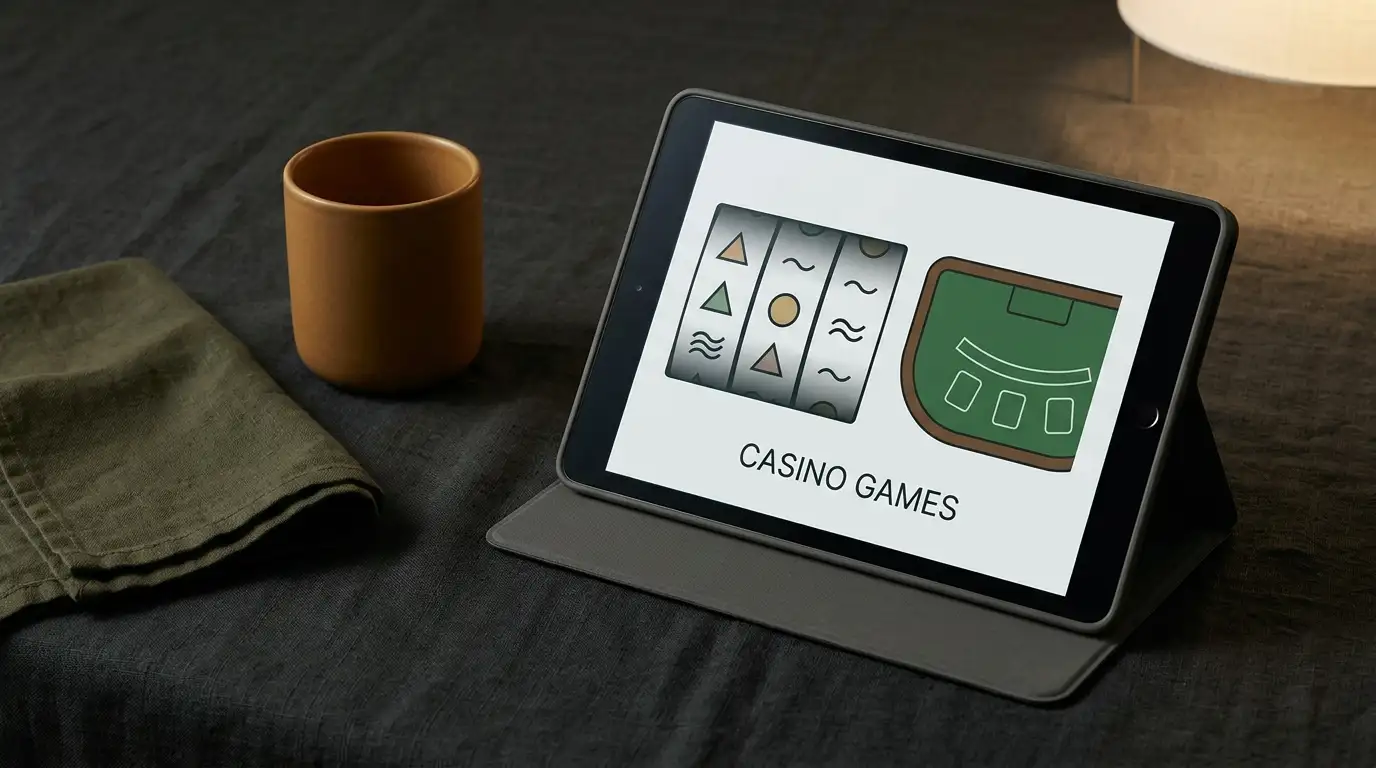
An Ethereum balance reaches the entire lobby at every site in this list. That is worth stating plainly because the phrase “crypto casino” leaves some players expecting a stripped-down room of dice and crash games, which was accurate around 2017 and has not been since. Once ETH is credited, the balance is a balance; Evolution’s live dealers do not know or care which rail funded it.
Pokies dominate everywhere, which reflects demand rather than a technical constraint. Live tables run through Evolution at Neospin, Ricky Casino and SkyCrown, and SkyCrown’s live room is the deepest of the AU-facing group. Fairspin carries roughly 500 table titles, unusual density for a crypto-first site. The genuinely crypto-native category — dice, crash, plinko, provably fair originals — exists at Stake, BC.Game, Fairspin and mBit, and is the one part of the lobby that has no equivalent at a card-only casino.
| Game category | Reachable with an ETH balance | Providers at these sites | What to watch |
|---|---|---|---|
| Pokies | Every site listed | BGaming, Pragmatic Play, Play’n GO, Hacksaw Gaming, Betsoft, Endorphina | mBit shows the return figure on the tile; nobody else does |
| Live dealer tables | Every site listed | Evolution at Neospin, Ricky Casino, SkyCrown | Bonus terms frequently exclude live play from wagering |
| Table games offline | Every site listed | Broad, deepest at Fairspin with ~500 titles | Low-edge games often contribute little toward wagering |
| Crypto-native originals | Stake, BC.Game, Fairspin, mBit | In-house studios | Provably fair verifies the result, not the edge |
| Sportsbook | Cloudbet, Stake, Vave, Fairspin | In-house odds | Cloudbet’s minimum bet runs to ten cents |
| Bonus buy features | Neospin, SkyCrown, Ricky Casino, 7Bit | Various | Usually barred while a bonus balance is active |
Mobile play needs no separate treatment, which is itself the answer. Every site here runs as a responsive browser platform rather than a native app, because app stores are unenthusiastic about real-money gambling software aimed at markets where it is prohibited. The only Ethereum-specific wrinkle is wallet handling: approving a send from a phone wallet is fiddlier than on a desktop, and mistyping or misreading a network selection on a small screen is exactly the error that loses deposits. Fund from a desktop where you can, or paste rather than type.
Can you play live dealer tables and pokies with an ETH balance, or only crypto-native games?
The whole lobby. Once your Ethereum is credited it is simply account balance, and Evolution live tables, thousands of pokies and table games all accept it. Crypto-native dice and crash games exist alongside them at Stake, BC.Game, Fairspin and mBit, but they are an addition rather than a limitation.
Bonuses on an ETH deposit, and the arithmetic behind them
Welcome offers at these sites run from 100 per cent up to A$10,000 at Neospin through to 325 per cent up to 4 BTC at mBit, with wagering requirements between forty and fifty times and expiry windows as short as Ricky Casino’s three days. Cloudbet is the interesting exception: US$2,500 with no wagering attached, which is rare enough in this category to be the main reason a bonus-conscious player would choose it.
The word “free” gets a lot of work in this part of the industry, and it is worth remembering what it is doing. A casino is not a charity, has never been a charity, and the money in a welcome package is an acquisition cost calculated against expected lifetime losses per registered account. Forty times wagering on a A$500 bonus means putting A$20,000 through the games before the balance is yours to withdraw, and the house edge applies to all twenty thousand. The offer is not a gift with a condition attached; the condition is the product.
Ethereum adds a variable that AUD bonuses do not have. If your balance is denominated in a coin and the coin moves while you clear the requirement, the sum you eventually withdraw reflects both your results and the market. Clearing 40x over a fortnight in a week where the coin drops ten per cent means beating the wagering requirement and still cashing out less than you deposited — a genuinely annoying way to be right and lose. This is the strongest practical argument for the stablecoin approach described earlier, or for the AUD-native structure at Neospin and Ricky Casino where the balance simply does not float.
New arrivals get their own paragraph and it is a short one. Sites launched in the last few months advertise the loudest terms in the market, because a bonus percentage costs nothing to publish and a payout record takes years to earn. Vave, launched in 2022, is the newest name here and it is also the one with a mutating licensee and documented withdrawal friction — not a coincidence. A cashier that works is not the same as a cashier that pays, and the only evidence that separates them is time.
Playing this without it playing you
The offshore structure has one more consequence, and it is the one that deserves the last word. Because every one of these sites operates outside Australian licensing, none of the domestic consumer protections reach them. There is no local regulator to complain to. There is no dispute process with statutory force. And BetStop — the National Self-Exclusion Register — covers Australian-licensed online and phone wagering services only, so a person who has excluded themselves from every legal betting account in the country can still register at one of these ten sites within minutes.
That last point is not a technicality. Self-exclusion works because it removes the option at the moment the option is most dangerous, and it cannot remove an option it has no jurisdiction over. Anyone who has used BetStop should treat the offshore market as the gap in their own protection and take the corresponding precautions — device-level blocking software, removing saved payment methods, and keeping crypto in a wallet that is deliberately inconvenient to reach.
The tools that do exist are the operators’ own, and their quality varies. mBit carries a six-tool responsible gambling kit — deposit limits, loss limits, session reminders, cooling-off, self-exclusion, reality checks — which is the most complete provision here and one of the reasons it rates well. Most of the others offer some subset. Set them at registration, while you are calm and the account is empty, because the interface for setting a deposit limit is significantly harder to find when you are chasing a loss at one in the morning.
Free confidential support is available in Australia around the clock. The National Gambling Helpline is on 1800 858 858, and Gambling Help Online provides chat and email counselling at any hour. Nothing about a decentralised payment rail changes what a losing streak does to a person, and a wallet that settles in four seconds mostly means the losses arrive faster.
Crypto Casinos Australia 2026 — Bitcoin, Ethereum, USDT & More
Content created by the «PokiePay» team