
Casinos that accept Neosurf in Australia: the voucher, the fine print, and the way back out
 Available in AU

What a Neosurf deposit actually buys you at an Australian-facing casino
Nine offshore casinos serving Australian players carry Neosurf in the cashier with conditions worth documenting: Fair Go, Ricky Casino, Uptown Pokies, Las Atlantis, Slots Empire, Ozwin, Two-Up, King Billy and Jackpot Jill. Minimums start at A$10 on the voucher — often below the card minimum at the same site. None of them can pay you back through it.
That last sentence is the whole topic in miniature. A Neosurf voucher travels one direction only, from the newsagent counter into a casino balance, and there is no mechanism anywhere in the product that pushes money back onto a 10-digit code. So the moment you choose the voucher, you have also committed to choosing a second, entirely separate method to get paid — bank transfer, PayID, crypto, an e-wallet. Two decisions, one of which most comparison pages forget to mention.
Neosurf itself is unglamorous and that is rather the point. It is a prepaid instrument from Neosurf Cards SAS, a French company registered as a payment institution with the ACPR, the French prudential regulator. You hand cash across a counter, you get a receipt with a ten-digit PIN printed on it, and that PIN carries a fixed value redeemable at merchants inside the Neosurf network. No plastic. No CVV. No standing link to your bank account. Conceptually closer to a Coles gift card than to a debit card, which is why the phrase “Neosurf debit casino” — a search plenty of Australians type — describes a product that does not exist.
The appeal for Australian players breaks into three concrete benefits, and it is worth being precise about which ones are real. Privacy at the deposit: genuine, because the transaction on your statement is a retail purchase at a shop, not a payment to a gambling merchant. Budget control: genuine, and arguably the strongest argument for the thing, since you physically cannot spend more than the voucher holds. Anonymity from the casino: partly true and widely oversold, because the operator still has to verify your identity before it releases a first withdrawal. The voucher hides your bank from the casino. It does not hide you.
Does Neosurf charge a fee on a casino deposit?
The casino side is free at every site in this guide — deposit a A$50 voucher and A$50 lands. The cost sits earlier, at the till: Neosurf’s retail purchase commission means a A$50 voucher costs around A$52, and a A$10 voucher costs around A$11.50. So “no fees” is accurate about the cashier and misleading about the instrument.
The nine sites that take Neosurf, side by side
Every one of the nine holds a Curaçao licence. Not one holds an Australian licence, for the straightforward reason that Australia does not issue them — more on that further down, because it changes how you should read the word “trusted” in this market. What the table below does differently from the usual ranking grid is give the payout rail its own column. When your deposit method cannot pay you, the quality of the method that can becomes the more important number.
| Operator | Licence | Neosurf minimum | Payout rail and speed | Distinguishing feature |
|---|---|---|---|---|
| Fair Go Casino | Curaçao; ACMA blocking request since Nov 2019 | A$10 (site states it three inconsistent ways) | Bank transfer, Bitcoin, Litecoin | Only site here with a Neosurf-specific bonus code, 100-NEOS |
| Ricky Casino | Curaçao Gaming Authority | A$10 on its voucher page, A$20 in general terms | PayID, crypto, bank transfer; A$30 minimum withdrawal | Broadest cashier of the nine — PayID sits beside the voucher |
| Uptown Pokies | Curaçao claimed, unverifiable in public sources | A$10 site-wide; A$25 to trigger code BANDIT125 | POLi, bank transfer, crypto | Roughly twelve years trading, 220+ RTG titles |
| Las Atlantis | Curaçao, published on the operator’s own licence page | A$10, against A$30 on a credit card | Bitcoin, Litecoin, Ethereum, bank transfer | Voucher costs a third of the card minimum to get in |
| Slots Empire | Curaçao | A$10, against A$20 crypto and A$30 card | Eleven cryptocurrencies, bank transfer; A$150 minimum cashout | Pays 20% extra for depositing by voucher or crypto |
| Ozwin Casino | Curaçao, held by Dama N.V. | Not published; card and crypto tiers start at A$10–A$20 | Bitcoin, bank transfer | Named operating company, six loyalty tiers to 50% cashback |
| Two-Up Casino | Curaçao, unverified setup | Low site-wide floor | Bank wire, crypto; A$100 minimum withdrawal, A$2,000 weekly cap | Sharpest gap between cheap entry and expensive exit |
| King Billy | Curaçao | Not published; AUD deposits reported from A$30 | Crypto, cards, bank transfer; ~A$4,000 daily cap | ~5,000 games and 30× bonus-only wagering |
| Jackpot Jill | Curaçao eGaming since 2021 | A$20 | PayID, POLi, Bitcoin; one logged PayID payout at 2 h 39 min | 100 zero-wager spins in the welcome package |
Two columns deserve a warning label. “Neosurf minimum” is the figure operators are least careful about publishing — Fair Go manages to state its own voucher minimum three different ways across its own site, and Ricky Casino’s brand pages say A$10 while its general deposit terms say A$20. Where a site has not published a voucher-specific floor at all, the table says so instead of inventing a number, which is the difference between a comparison and a decoration.
The other is the payout column. Notice that only two of the nine put PayID in front of Australian players. That is not a minor convenience difference. PayID moves money on the domestic bank rail in seconds and costs nothing, whereas a bank wire out of an offshore operator can take the better part of a week and a crypto payout requires you to own a wallet and understand what you are doing with it.
What is the smallest Neosurf deposit an Australian casino will accept?
A$10 at Fair Go, Las Atlantis, Slots Empire and Uptown Pokies, which matches the smallest voucher sold in Australian retail. A$20 is the more common site-wide floor. No casino accepts a A$5 Neosurf deposit, because no A$5 voucher exists — the retail grid starts at A$10 and offers no custom amounts.
Each site’s Neosurf cashier, taken one at a time
Ordering here follows the voucher, not the general site rating. A casino with a mediocre lobby and an honest A$10 voucher floor is more relevant to someone holding a printed PIN than a glossier operation that buries the prepaid option three clicks deep.
Fair Go Casino
The elder statesman of the Australian-facing Realtime Gaming cohort, trading since 2017 in Australian dollars with a catalogue of roughly 250 titles. Curaçao licence, no Australian licence, and one detail that belongs at the top rather than in a footnote: the ACMA has asked Australian internet providers to block the domain since November 2019, so whether you can reach it at all depends on your network. Its operating entity is not clearly disclosed on the site, which is standard for this cohort and worth naming as a gap rather than glossing over.
Fair Go is the only site of the nine that runs a promotion attached specifically to the voucher. Code 100-NEOS doubles a Neosurf deposit, and the terms it drags along are the interesting part: a A$20 minimum to qualify, 30× wagering calculated on deposit plus bonus, a A$10 ceiling on any single bet while the bonus is live, and pokies-weighted game eligibility. Run the arithmetic on the smallest qualifying deposit and a A$20 voucher becomes a A$40 balance carrying A$1,200 of required turnover. There is one genuinely good clause in there — deposit-bonus winnings carry no maximum cashout, which is unusual in this market and much better than the treatment of its no-deposit chips, where the return caps out at five times the bonus, generally around A$180.
Here is the trap the site’s own documentation sets. The Neosurf floor is A$10. The bonus floor is A$20. Buy the smallest voucher on the rack, deposit it successfully, and you have cleared the cashier while missing the promotion entirely — and nothing in the deposit flow tells you that. Suits a player who wants the longest AU track record on the list and is prepared to work around an ISP block. Poorly suited to anyone who needs a fast, domestic way out, because bank transfer and two cryptocurrencies is the whole exit menu.
Ricky Casino
A multi-provider operation under a Curaçao Gaming Authority licence, built for the Australian market and running an Australian-dollar cashier over a library in the region of 2,500 to 3,000 titles. The welcome structure is the longest ladder in this group: up to A$7,500 and 550 free spins spread across the first ten deposits, which is less generous than it sounds and more useful than a single-shot match, since it rewards the way most people actually top up.
What earns Ricky its position is the cashier itself. Neosurf sits alongside Visa, Mastercard, PayID, AstroPay, CashToCode, ezeewallet, BPAY, Neteller, Skrill, bank transfer and crypto — the broadest rail set of the nine. Given the structural problem this entire page circles around, that breadth is the feature. Cash in at the newsagent, cash out through PayID on the domestic bank rail, in one account, without maintaining a crypto wallet you did not want. Minimum withdrawal is A$30. Voucher denominations accepted run A$10, A$20, A$50 and A$100.
The blemish is documentation. Its Neosurf landing page states a A$10 minimum; its general deposit terms and every independent review state A$20. One of those is stale and there is no way to tell which from the outside, so open the live cashier before you buy a voucher — a A$10 PIN rejected at a A$20 gate is a trip back to the shop, not a disaster, but it is avoidable.
Uptown Pokies
Around twelve years of continuous trading makes this the longest-running brand in the guide, which in a market this transient counts for something. Realtime Gaming powers a deliberately small library — 220-odd pokies and table games — with Australian-dollar banking and both POLi and Neosurf listed as local rails. The welcome chain runs across six deposits up to A$8,888, with a A$10 no-deposit bonus for anyone who wants to look around before committing cash.
The licence needs stating plainly: Curaçao is claimed, and at least one independent reviewer has described the licence as unverifiable from public sources. That is not the same as an accusation. It means the paperwork cannot be confirmed by an outsider, and a reader handing over cash at a counter is entitled to know that the confirmation is missing rather than be handed a reassuring badge. Twelve years without a public payout scandal is real evidence. It is just a different kind of evidence than a verifiable licence number.
Watch the threshold again, because Uptown Pokies sets it higher than most. The site-wide floor is A$10, but the headline “Play with $125” offer under code BANDIT125 needs A$25 — a figure that matches no voucher denomination at all. You would be buying a A$30 voucher and leaving A$5 stranded on the code, or stacking a A$20 and a A$10 and paying retail commission twice. Small money. Irritating structure.
Las Atlantis
An underwater-themed Realtime Gaming site, structurally a sibling of Slots Empire, serving Australian players in Australian dollars. It does something the rest of the cohort mostly avoids: it publishes its full minimum-deposit grid on its own licensing page. A$10 on Neosurf. A$20 on Bitcoin, Litecoin or Ethereum. A$20 on Flexepin. A$30 on a credit card. The welcome code is valid five times, applying to each of the first five deposits, with headline offers reaching 250% through crypto and a 220% tier aimed at higher-volume crypto players.
That grid is the cleanest evidence available that the voucher is the cheap door. Thirty dollars to get in with a card, ten with a Neosurf PIN — a third of the committed stake for the same account, the same lobby, the same terms. If your intention is to test a site with the smallest amount of money it will accept, the prepaid rail is not merely tolerated here, it is the most permissive option on the page.
The other side of that ledger is the exit, which runs to Bitcoin, Litecoin, Ethereum and bank transfer with no domestic instant rail. So Las Atlantis fits a player who wants minimum exposure on entry and is comfortable receiving winnings in crypto. Anyone who wants Australian dollars landing in an Australian bank account within the hour is shopping at the wrong site, whatever the deposit minimum says.
Slots Empire
Same published-grid discipline, same Realtime Gaming foundation, Curaçao licence. The numbers, straight from the operator’s own Neosurf page: A$10 minimum on the voucher, A$20 on Bitcoin, Ethereum, Litecoin or USDT, A$20 on Flexepin, A$30 on a credit card. Bonus code valid five times. Maximum bet A$10 while a bonus is active. Maximum cashout 30× the deposit. Wagering 40× deposit plus bonus. Eligible games restricted to pokies, Real-Series video slots, keno and scratch cards. The lobby holds around 1,300 pokies and more than 60 live dealer tables, with eleven cryptocurrencies in the cashier and a A$150 minimum cashout.
Alone among the nine, Slots Empire pays you extra for using the voucher. The welcome structure offers a choice of 100% to 270% on each of the first three deposits, plus a 20% uplift for funding by Neosurf, Flexepin or crypto. So the prepaid rail is bonus-positive rather than bonus-neutral, which reverses the usual industry treatment of vouchers as second-class money.
Then read the cap. Maximum cashout is 30× the deposit, so a A$10 voucher deposit bounds your winnings at A$300 no matter what the reels do, and the 20% uplift is a slightly bigger slice of a firmly closed box. Layer the A$150 minimum cashout on top and the small-voucher strategy gets awkward fast: your winnings have to clear A$150 to be withdrawable at all, from a balance capped at A$300. The generosity is real. The room to use it is narrow.
Ozwin Casino
Launched in 2020, Australian-themed, operated by Dama N.V. under a Curaçao licence, running Realtime Gaming with SpinLogic across a library of roughly 200 titles weighted to pokies, video poker and specialty games. The welcome structure quotes 400% up to A$4,000 with 100 free spins across the first two deposits, plus a A$10 trial for the curious, and a six-tier loyalty programme that reaches 50% cashback at the top.
The Dama N.V. detail deserves more weight than a bonus percentage. Most sites in this cohort present a brand and no company — no named licensee, no jurisdiction of incorporation, nothing you could look up. Ozwin names the entity holding the licence. When your deposit is cash handed across a counter, with no chargeback, no bank intermediary and no Australian regulator to complain to, knowing who is actually on the licence is a form of protection you cannot get any other way.
What Ozwin does not publish is a Neosurf-specific minimum. Its card and crypto tiers sit in the usual A$10 to A$20 band, and the voucher almost certainly lands in the same range, but “almost certainly” is not a number and this guide is not going to print one. Check the live cashier. The other honest caveat: independent reviewers rate the site in the middle of the pack, and the Australian regulatory position leaves you without a domestic regulator regardless of how the loyalty tiers look.
Two-Up Casino
Named after the coin game Australians are legally allowed to play on one day a year, which is a decent joke and roughly the level of Australian authenticity on offer. Realtime Gaming pokies, bingo and scratch cards, Neosurf and crypto in the cashier, match bonuses across the first three deposits, and a Curaçao setup that independent reviewers describe as unverified. The deposit floor is low.
The exit is where this site earns its place in the guide, and not as a compliment. Minimum withdrawal is A$100. The weekly withdrawal cap is A$2,000. Reviewers consistently report slow bank wires and heavy wagering requirements. Put the deposit floor and the withdrawal floor side by side and the asymmetry is stark: you can walk in with a A$20 voucher and you cannot walk out with anything under A$100. Turn a A$20 deposit into A$80 of winnings here and the money is not yours in any practical sense — it is a number on a screen that can only be spent inside the building.
That structure is worth understanding as a general pattern rather than a Two-Up peculiarity, because it is exactly what the small-deposit marketing obscures across this whole market. A low entry price is easy to advertise and costs the operator nothing. The number that determines whether you ever see your money is the withdrawal minimum, and it appears in a different table on a different page, if at all. Two-Up suits nobody depositing small amounts. For anyone else, the A$2,000 weekly ceiling means a decent win gets paid out in instalments over a month.
King Billy
Launched in 2021, Curaçao-licensed, with the largest catalogue in the guide at roughly 5,000 games — slots-led, a thinner table selection, sourced across dozens of studios. The welcome package is quoted at A$3,000 plus 300 free spins, Australian-dollar deposits are reported from A$30, and a daily withdrawal cap of around A$4,000 applies. Some sources claim a Malta licence alongside Curaçao; that could not be confirmed, so treat Curaçao as the operative jurisdiction and no Australian regulator as the operative reality.
The number that actually distinguishes King Billy is buried in the bonus terms: wagering runs at 30× the bonus only, not 30× deposit plus bonus. Same headline multiplier as Fair Go, roughly half the work. On a A$100 deposit with a A$100 match, bonus-only 30× means A$3,000 of turnover, while deposit-plus-bonus 30× means A$6,000. Nobody puts that distinction in a comparison table because it does not fit in a cell, and it moves the real cost of a bonus more than any percentage on the landing page.
King Billy does not publish a Neosurf-specific minimum either, and the A$30 Australian-dollar figure reported for deposits sits above the smallest two voucher denominations. So the voucher is accepted, the exact floor is undocumented, and a A$10 PIN may or may not clear. For a site with a five-thousand-game lobby and a comparatively humane wagering structure, that is a frustrating gap in the paperwork — check before you buy, not after.
Jackpot Jill
A fantasy-themed, Australian-facing site running on a Curaçao eGaming licence since 2021, with an Australian-dollar cashier and registration that takes under five minutes. The lobby carries more than 2,000 real-money games including 1,500-plus pokies, 28 live dealer tables and 23 jackpot titles. Minimum deposit is A$20. The welcome package reaches A$7,500 with 100 free spins across five deposits, and — the clause that matters — 100 of those spins carry zero wagering.
Zero-wager spins are rare enough to be worth pausing on. A normal free spin hands you winnings that must be turned over thirty or forty times before they convert into money, which is the industry’s way of giving you a “gift” and keeping the receipt. Zero-wager means what it says: win on the spin, the money is withdrawable. That single term is worth more to a small depositor than several thousand dollars of theoretical match bonus attached to a A$1,200 turnover requirement.
On the exit — the thing that actually decides this choice — Jackpot Jill posts a 24-hour review window with payouts quoted at 24 to 72 hours, and one independent reviewer logged a PayID withdrawal completing in 2 hours 39 minutes. PayID and POLi both sit in the cashier beside cards and Bitcoin. For a Neosurf depositor forced to nominate a separate payout rail regardless, a documented sub-three-hour domestic payout is the most valuable single fact in this entire guide. The A$20 minimum deposit is the trade: no A$10 entry here.
Does a Neosurf deposit still qualify for the welcome bonus?
Usually yes, but the bonus threshold is often higher than the deposit threshold. Fair Go accepts A$10 vouchers and requires A$20 for code 100-NEOS. Uptown Pokies needs A$25 for BANDIT125. Slots Empire goes further and pays 20% extra for prepaid deposits. Buy the voucher that matches the bonus floor, not the deposit floor.
Buying the voucher: retailers, denominations, and the fee nobody prints
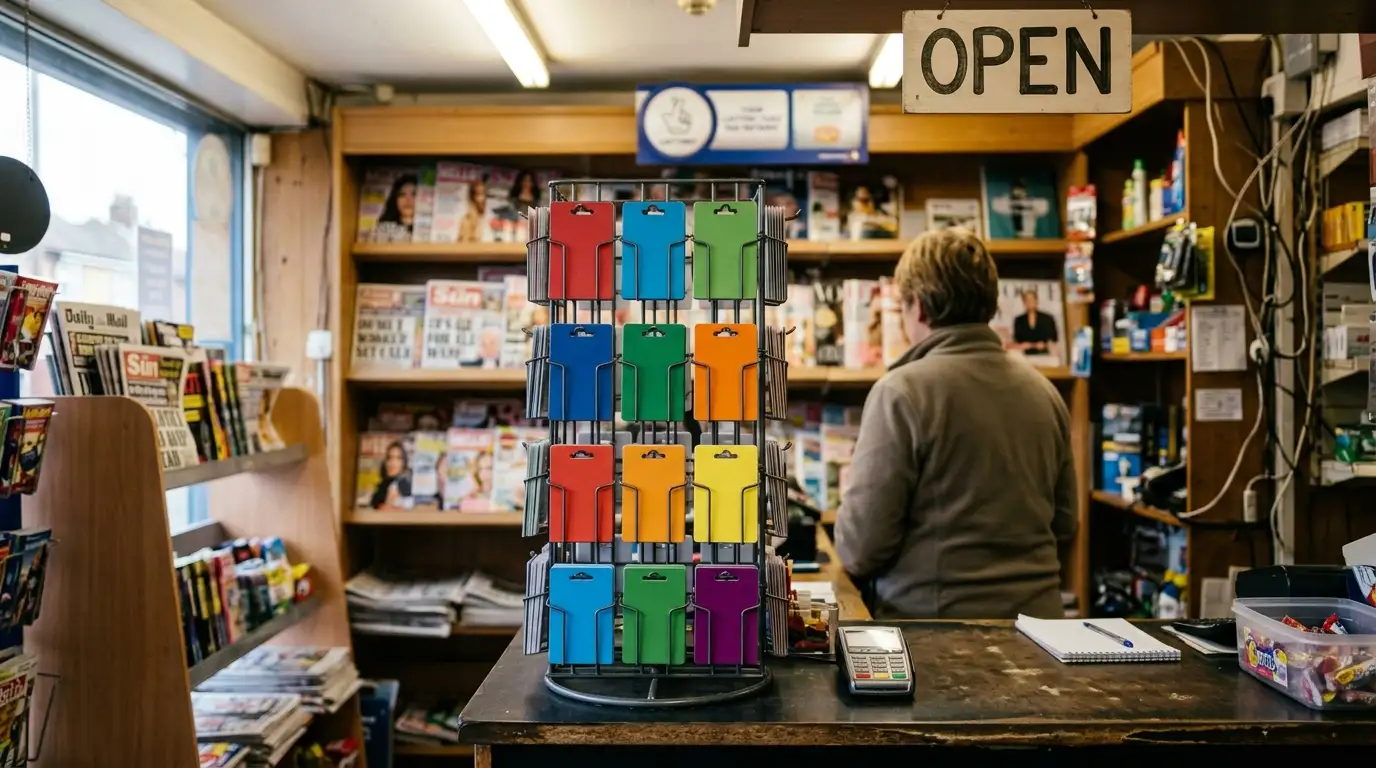
Neosurf’s Australian distribution is retail-first and deliberately mundane. The voucher lives on the same gift-card rack as Netflix and Steam credit, sold by staff who have no idea what you intend to do with it and no obligation to care. That ordinariness is the product’s real feature — a Neosurf purchase reads on a bank statement as a shop transaction, because that is exactly what it is.
Where the vouchers actually sit on the shelf
| Outlet | Typical AU denominations | Cash or card | Metro versus regional |
|---|---|---|---|
| Newsagents | A$10 – A$100 | Cash or card | Widest denomination spread, coverage inconsistent — ring ahead |
| Coles | A$10 – A$500 depending on store | Cash or card | Largest network, gift-card wall, metro-weighted |
| Australia Post | A$10 – A$100 | Cash or card | Best at major branches, patchier at licensed post offices |
| 7-Eleven | A$20 – A$100 | Cash or card | Metro-heavy, availability varies by franchise |
| Service stations (BP, Caltex) | A$10 – A$50 | Cash or card | Solid in both metro and regional |
| Online resellers | A$10 – A$250 | Card or PayPal | Anywhere, emailed in minutes, kills the cash anonymity |
The standard Australian denomination set is A$10, A$20, A$30, A$50 and A$100. Higher tiers exist in the system — A$150, A$200, A$250 and A$500 — but availability thins sharply as the value climbs, and terminals frequently are not configured for the top end. A$500 is the ceiling on a single voucher, a limit tied to anti-money-laundering controls on cash-origin instruments rather than to any technical constraint. There are no custom amounts. You cannot ask for A$37, and the A$5 voucher that several search queries assume exists has never existed.
Buying online through the authorised resellers is faster than finding a stockist and defeats the purpose. Pay by card or PayPal and you have reintroduced exactly the bank record the voucher was meant to avoid, while adding a reseller markup of a few per cent for the privilege. Unofficial third-party sellers are worse: markups in the ten to twenty per cent range plus counterparty risk on a product with no dispute mechanism. If privacy is why you are here, buy in a shop with cash.
One more thing about the receipt. That printed PIN is bearer value — whoever holds the ten digits controls the money, with no name attached and no way to reverse a redemption. Neosurf’s own terms state it cannot replace an unredeemed voucher when the PIN cannot be verified. Photograph the code the moment you leave the shop, keep the photo somewhere sensible, and treat the paper like the cash it replaced. There is also a dormancy fee: leave a voucher unspent for around twelve months and it begins losing value monthly. Vouchers are not a savings product.

Why the A$10 voucher is the expensive one
Every comparison page in this market leads with the A$10 minimum deposit as the headline benefit. Not one of them subtracts the retail commission, which is where the actual money goes.
| Voucher face value | Indicative purchase price | Effective cost of getting A$X into the account |
|---|---|---|
| A$10 | ~A$11.50 | ~15% |
| A$20 | ~A$21.50 | ~7.5% |
| A$30 | ~A$31.50 | ~5% |
| A$50 | ~A$52.00 | ~4% |
| A$100 | ~A$103.50 | ~3.5% |
Read the right-hand column and the sales pitch inverts. The cheapest-looking door is by a wide margin the most expensive per dollar deposited — around fifteen per cent to get A$10 into play, against roughly three and a half per cent on a A$100 voucher. Same instrument, same cashier, four times the efficiency at the larger denomination. Exact figures vary by retailer contract, since Coles negotiates different terms from an independent newsagent, but the shape of the curve holds everywhere.
Now stack that against how the small-deposit market advertises itself. A site trumpeting “A$10 minimum with Neosurf” is describing a transaction where you pay about A$11.50 for A$10 of playing balance, then discover that the welcome bonus needs A$20, so you go back and buy a second voucher and pay commission twice. Two trips, two fees, and you have landed on the A$20 threshold by the most expensive route available — roughly A$33 spent to reach a A$30 balance, against A$31.50 for a single A$30 voucher that would have cleared the same gate.
None of which makes Neosurf a bad instrument. It makes the A$10 voucher a bad default. If you know your session budget, buy that denomination once: the fee curve rewards you for deciding in advance, which happens to be the same behaviour that keeps a bankroll intact. Rarely do a payment product’s economics and a player’s interests line up so neatly. Enjoy it while it lasts.
Where can you buy a Neosurf voucher in Australia?
Newsagents, Coles gift-card walls, Australia Post branches, selected 7-Eleven stores and many service stations, with denominations from A$10 to A$100 and higher tiers at some Coles outlets. Cash or card at the counter. Neosurf runs a postcode store locator on its own site. Coverage is metro-weighted, so regional players should call ahead.

From receipt to balance: the deposit itself
The mechanics are genuinely simple and the sequence matters more than the steps. Register first and verify your identity the same day, before any money moves — the voucher is anonymous, the withdrawal never will be, and doing the paperwork while you are calm beats doing it while waiting on a payout. Then open the cashier, select Neosurf from the deposit methods (usually filed under vouchers or prepaid), type the ten-digit PIN exactly as printed with no spaces, enter the amount, and confirm.
Credit lands in two to fifteen minutes at the sites in this guide, effectively instant at most of them. That is slower than PayID’s sub-ten-second transfer and quick enough that nobody notices the difference. Keep the retailer receipt until the balance appears — if a redemption fails or a PIN is disputed, the receipt is the only proof of purchase you have, and there is no bank sitting behind the transaction to arbitrate.
Depositing on a phone works identically, because redemption is a text field and a form button. Nothing about the voucher requires an app, though Neosurf publishes one for checking balances and managing codes. The “mobile Neosurf casino” that several searches ask for is simply any of the nine sites above, opened in a phone browser.
Stacking vouchers is where cashiers diverge. Some accept PINs back to back inside a single deposit flow. Others make you complete one transaction before starting the next. A few route everything through a free myNeosurf web wallet, where you load several codes and deposit the combined balance in one go — the tidiest approach if you regularly deposit more than A$100. Worth knowing before you are standing at a counter on a Saturday: retailers may baulk at selling three or four high-value vouchers in one transaction, since their own point-of-sale scripts flag large cash gift-card purchases and staff may ask for identification under the reporting procedures they operate. Not sinister. Just friction to plan around.
What happens when the voucher is worth more than the deposit
In the Neosurf system, partial redemption is standard: use A$30 of a A$50 voucher and the remaining A$20 stays live on the code for later, or can be swept into a myNeosurf wallet. The complication is on the casino side, where behaviour is not uniform. Some cashiers take the full voucher value regardless of what you typed in the amount field.
That difference matters more than it sounds, because it destroys the single best argument for using a voucher. The hard cash ceiling — you can only lose what is on the code — assumes you control how much of the code enters the account. If the site absorbs the whole A$100 when you meant to deposit A$20, the pre-commitment device has quietly become an ordinary deposit with extra steps and a retail fee attached. Buy the denomination you actually intend to spend and the problem cannot arise, which is the same advice the fee curve gives for entirely different reasons.
What happens if you deposit less than the full value of your voucher?
Neosurf leaves the unspent balance on the ten-digit code for future use, or you can consolidate it in a free myNeosurf wallet. Some casino cashiers, though, absorb the entire voucher value regardless of the amount you enter. Check the site’s own voucher terms first, or simply buy the denomination matching your intended deposit.

Getting paid: the rail the voucher can’t be
No casino on earth withdraws to Neosurf. The product has no mechanism for it — a voucher is a value token issued at a retailer, and there is no path back onto a code that has already been redeemed. Every search for an “instant Neosurf withdrawal casino” is chasing a product that cannot exist, and every affiliate page promising one is either careless with words or counting on you not to read past the heading.
Which rails these sites actually pay through
Four categories cover the nine sites. Bank transfer is universal and slow, typically several business days out of an offshore operator, sometimes longer if a compliance review lands in the middle. Cryptocurrency is the fastest option at the Realtime Gaming cohort — Bitcoin, Litecoin, Ethereum and USDT appear across Las Atlantis, Slots Empire, Ozwin, Two-Up and Fair Go, with payouts commonly quoted from ten minutes to an hour after approval. PayID and POLi, the domestic Australian rails, appear at only two of the nine: Ricky Casino and Jackpot Jill. E-wallets like MiFinity, Jeton and ezeewallet turn up on the newer multi-provider sites.
Which gives the Neosurf depositor a genuinely awkward choice. The prepaid voucher exists to keep your bank out of the transaction — and the fastest way to get paid, PayID, puts your bank right back in it. If bank-side privacy was the whole reason you bought a voucher, crypto is the only exit that preserves it, which means learning to hold a wallet. If privacy was really about avoiding a gambling line on a statement rather than avoiding banks in general, PayID on the way out costs you nothing and pays in hours. Decide which of those you actually wanted before you pick a site, because the site choice locks it in.
The withdrawal minimums that undo a small deposit
Here is the pairing no comparison page prints, and the reason to read a cashier’s exit terms before its entry terms.
Two-Up takes a low deposit and enforces a A$100 minimum withdrawal with a A$2,000 weekly cap. Slots Empire takes A$10 on a voucher and requires A$150 to cash out. Casinonic, a brand that appears near the top of most Neosurf lists, advertises a A$10 minimum deposit against a A$300 minimum withdrawal — a thirtyfold gap between what it takes to get in and what it takes to get out. Ricky Casino, by contrast, pairs its voucher deposit with a A$30 withdrawal floor, and King Billy’s constraint is a ceiling rather than a floor at roughly A$4,000 a day.
Work through what those numbers do to a small player. Deposit A$10 at a site with a A$150 cashout minimum, run it up to A$120 — a good session by any measure — and you have won nothing you can collect. The balance is real, withdrawable only in theory, and the only thing you can do with it is keep betting until it either clears A$150 or, far more likely, returns to the house. The withdrawal minimum is not an administrative detail. On a small bankroll it is the single term that determines whether the concept of winning applies to you at all.
So the sequence for choosing among these nine inverts the way the market presents them. Find the sites whose withdrawal minimum sits below what you could plausibly win from your intended deposit. Of those, pick the one with the fastest rail you can actually use. Only then look at the bonus. Neosurf integration is a checkbox — nine sites have it, and the differences between them at the deposit end are worth a few dollars. The differences at the payout end are worth all of it.
Can you withdraw your winnings to a Neosurf voucher?
No, and no casino can offer it. Neosurf is a one-way prepaid instrument: value flows from the retailer into a merchant account and there is no path back onto a redeemed code. You nominate a separate payout method — bank transfer, PayID, crypto or an e-wallet — and identity verification applies before the first withdrawal clears.

What the law says about all of this
The Interactive Gambling Act 2001 is the governing statute and it points in a direction most players get backwards. The Act makes it illegal to provide prohibited interactive gambling services to a person in Australia. Prohibited services expressly include online casino-style games — pokies, roulette, blackjack, craps, online poker — along with in-play sports betting, unlicensed sports betting and betting on lottery outcomes. Advertising those services in Australia is banned as well.
The obligations bind operators and advertisers. Not players. The Act imposes no penalty on an Australian individual for depositing at an offshore casino, and no Australian has been prosecuted as a player. What you lose is not liberty but recourse: when a dispute arises with a Curaçao-licensed operator, there is no Australian regulator to escalate to, no local ombudsman, and no domestic legal instrument compelling the site to pay you. That is the real trade, and it applies identically whether you funded the account with a voucher, a card or crypto.
Enforcement runs through the Australian Communications and Media Authority, which requests that internet providers block services found in breach. Those requests are not theoretical and they land on brands that appear in Neosurf guides. The July 2026 blocking round covered Zizobet, KingAUD, Lucky Vibe, Daily Spins and Gambiva, along with a domain imitating a licensed betting service. Fair Go has been the subject of a blocking request since November 2019. Since the 2017 amendments strengthened the ACMA’s tools, more than 220 online gambling services have withdrawn from the Australian market altogether. If you find a site on somebody’s recommended list and your connection cannot reach it, that is frequently the explanation — and the fact that a list still recommends it tells you the list was not checked.
Why there is no Australian-licensed Neosurf casino
Australia issues no online casino licences. None. The ACMA maintains a register of Australian-licensed interactive wagering providers, covering sports and race betting plus lotteries, and there is no casino equivalent because the Act prohibits the activity rather than regulating it. So the search for a “licensed Australian casino that accepts Neosurf” is looking for a category the law does not create.
This has a consequence worth stating for anyone who relies on it. BetStop, the National Self-Exclusion Register, lets you exclude yourself from every Australian-licensed online and phone wagering service in a single step at betstop.gov.au. It does not reach offshore casinos, because they are outside the licensing framework it operates on. A player who has self-excluded through BetStop and assumes the block covers the sites in this guide is mistaken, and the gap is structural rather than an oversight. Free, confidential support runs 24 hours a day on the National Gambling Helpline, 1800 858 858, and through Gambling Help Online.
One adjacent point on payments, since it explains why vouchers persist in this market. The 2020 ban on credit-card gambling transactions bites on payments coded to gambling merchants. A Neosurf voucher bought at Coles rings up under the retail gift-card code, not the gambling one, so the ban does not automatically catch it — though individual banks run their own fraud profiling and may decline repeated gift-card purchases anyway. And on tax: recreational gambling winnings are not assessable income in Australia under the long-standing Taxation Office ruling, regardless of which rail funded the account.
What changes on 1 January 2027
The Interactive Gambling Amendment (Gambling Reform) Bill 2026 passed the Australian Parliament on 19 August 2026, with most provisions commencing 1 January 2027. It restricts gambling advertising across television, radio, online and sports venues, creates a global opt-out register for gambling ads, and limits direct marketing of inducements — to new account holders during their first fourteen days, to anyone who deregistered from BetStop within the previous three months, and to all customers identified as at risk of gambling harm. It bans commissions paid to staff or affiliates based on customer activity. It strengthens enforcement, adding takedown powers for both advertisements and illegal services, and reinforces how BetStop operates.
What it does not do is open a licensing path for online casinos. The direction of Australian policy is tighter enforcement against offshore operators, not domestic legalisation, and the reform’s affiliate-commission ban aims squarely at the machinery that produces the ranking pages this topic is drowning in. For a Neosurf player the practical read is short: expect fewer visible advertisements, expect more blocked domains, and expect the offshore market you are dealing with to remain offshore.
Is it illegal for an Australian to play at a casino that accepts Neosurf?
No. The Interactive Gambling Act 2001 penalises operators who supply online casino games to Australians, not the players who use them, and no Australian has been prosecuted for playing. The cost is recourse rather than legality: no Australian regulator oversees these Curaçao-licensed sites, so disputes have no domestic escalation path.
What the money plays once it lands
The payment method does not gate the lobby. A Neosurf-funded balance behaves like any other balance — it plays pokies, live dealer tables, roulette, blackjack, baccarat, video poker, jackpot titles and whatever crash-style games the site has bolted on. There is no separate “voucher section”, no restricted catalogue, and the “Neosurf pokies” and “Neosurf roulette” that searches ask for are simply the ordinary games at a site that happens to take vouchers.
Where the sites genuinely differ is software, and that splits the nine cleanly in two. The veteran Australian-facing cohort — Fair Go, Uptown Pokies, Ozwin, Two-Up, Las Atlantis and Slots Empire — runs Realtime Gaming, sometimes with SpinLogic alongside. Catalogues are small by design, from roughly 200 titles at Ozwin and Uptown Pokies to about 1,300 at Slots Empire, built around Real-Series video slots and a progressive jackpot network with themes that have been on Australian screens for years. The newer multi-provider cohort — Ricky, King Billy, Jackpot Jill — aggregates dozens of studios: Pragmatic Play, NetEnt, BGaming, Platipus, Microgaming, Playtech, Yggdrasil, with Evolution supplying live tables.
Five thousand games sounds decisively better than two hundred until you count what you actually open. Most players rotate through a handful of titles and ignore the rest, which makes catalogue size the most-quoted and least-useful column in this market. A 200-title Realtime Gaming lobby that loads fast and pays reliably beats five thousand titles at a site that reviews its withdrawals for a week. Live dealer coverage is the exception where volume genuinely matters — 28 tables at Jackpot Jill or 60-plus at Slots Empire is a materially different product from a site with four.
Why the bonus terms care which game you open
Slots Empire publishes its eligible-game list, and it is instructive: pokies, Real-Series video slots, keno and scratch cards. That is the whole list. The live dealer tables — 60-plus of them, a headline feature of the site — contribute nothing toward clearing a bonus. So the 20% uplift for depositing by voucher is collectable on the reels and nowhere else.
This pattern repeats across the cohort with minor variations. Table games and live dealer play are typically excluded outright or weighted so low that clearing turnover through them is impractical, because their house edge is thin and the operator has no interest in subsidising a low-margin game with bonus money. Fair Go’s 100-NEOS terms carry the same pokies weighting. A player who funds an account with a voucher specifically to play blackjack should therefore decline the bonus rather than accept it, take the deposit at face value, and keep the freedom to play what they came for. Declining a “gift” is sometimes the profitable move — a sentence the marketing department would prefer you never read.
Max bet clauses deserve equal attention because breaching one voids winnings outright. Both Fair Go and Slots Empire cap single bets at A$10 while a bonus is active. Spin A$15 once on a A$40 balance and the terms permit the operator to confiscate everything that follows. No warning appears at the moment of the spin. The clause simply sits there, waiting.
Do you still have to verify your identity if you deposited with a voucher?
Yes. Neosurf keeps your bank out of the deposit, not your identity out of the account. Every operator here requires identification documents before releasing a first withdrawal, under the anti-money-laundering obligations attached to its licence. The voucher’s anonymity ends the moment you try to take money out.
Newer arrivals and whether they are worth the voucher
New Neosurf sites appear constantly, and they tend to have the cleanest prepaid integration in the market. That is not an accident. A brand launching in 2026 builds its cashier around what Australian players actually use, so the voucher sits on the first screen rather than buried under cards, and the technical implementation is current. Compared with a 2017-vintage Realtime Gaming skin, a new site frequently handles the same voucher more smoothly.
Which sets up an inverse relationship the “new Neosurf casino” search never confronts. The newest sites have the best voucher handling and the shortest payout record. No accumulated evidence of behaviour under pressure, no history of how a A$4,000 withdrawal request gets treated in month eighteen, no track record of whether the terms get reinterpreted when a player wins. For a payment method that is cash-bought, irreversible and unprotected by any chargeback, that is precisely the wrong trade — you are pairing the least recoverable deposit instrument with the least proven counterparty.
Twelve years of Uptown Pokies paying its players is a form of evidence that a slick 2026 cashier cannot replicate at any price. It is not proof of anything, and longevity in this market has covered plenty of mediocrity, but it is the only evidence available when no Australian regulator stands behind either option. So the practical rule for new arrivals is modest exposure: if a new site interests you, test it with one small voucher and a withdrawal request, before it holds anything you would mind losing. The welcome bonus will still be there next month, assuming the site is.
When Neosurf is the wrong tool
For most Australian players, most of the time, PayID is the better instrument and it is worth saying that plainly on a page about Neosurf casinos. Free, bidirectional, and settling on the domestic bank rail in under ten seconds against the voucher’s two to fifteen minutes and three-and-a-half to fifteen per cent retail commission.
PayID, Flexepin and CashtoCode compared
| Method | Issuer and origin | AU amounts | Fee | Deposit speed | Can it pay out |
|---|---|---|---|---|---|
| Neosurf | Neosurf Cards SAS, France; ACPR-registered | A$10 – A$500, common set A$10 – A$100 | 3.5% – 15% at retail, nothing at the cashier | 2 – 15 minutes | No |
| Flexepin | Novatti Group, Australian, ASX-listed | A$20 – A$500 | Retail purchase fee | Minutes | No |
| CashtoCode | Malta-licensed | A$10 – A$200 | Retail fee | Minutes | No |
| PayID / OSKO | Australian bank rail | No fixed denominations | Zero | Under 10 seconds | Yes |
| Crypto | Bitcoin, Litecoin, Ethereum, USDT | No fixed denominations | Network fee | Minutes | Yes |
Flexepin is the closest competitor and the more Australian one — issued by Novatti Group, an ASX-listed Australian company, in denominations from A$20 to A$500, with acceptance that has grown steadily since 2022. Both Las Atlantis and Slots Empire list it beside Neosurf at a A$20 minimum against Neosurf’s A$10, so Neosurf remains the lower door where both are offered. CashtoCode covers similar ground with a thinner Australian retail network.
Put a number on the fee difference, because it is larger than it looks over a year. A player depositing A$100 a week by voucher pays roughly A$3.50 a week in retail commission at the efficient denomination — about A$180 a year. Buy in A$20 vouchers instead, at 7.5%, and the same annual volume costs about A$390. PayID costs nothing at either volume. That A$180 to A$390 is not a fee on winnings or a term buried in a bonus. It is money that never reaches your balance, paid for privacy you may or may not need.
So the honest case for Neosurf narrows to three situations. Your bank has begun declining gambling payments and PayID transfers are bouncing. You want a hard, physical ceiling on a session and know from experience that a soft limit is not enough. Or you specifically want no offshore casino payment appearing on a statement that somebody else might read. Each of those is a real reason and worth the commission. Wanting anonymity from the casino itself is not on the list, because identity verification arrives before your first withdrawal regardless.
That middle reason deserves its due rather than a token paragraph. A prepaid voucher is genuinely one of the better structures available for keeping gambling spend bounded — you decide the amount while standing in a queue at a newsagent, sober and unhurried, rather than at 1 a.m. with a card saved in a browser and a run of bad spins behind you. The pre-commitment is physical and it holds. Where it stops working is the drip: a fresh A$10 voucher every second day is the same spend as a weekly A$50 with four times the commission and a pattern that usually means chasing. If you recognise that rhythm in your own receipts, the voucher has stopped being a limit and become a ritual, and no payment method fixes that. Gambling Help Online and the National Gambling Helpline on 1800 858 858 are free, confidential and available at any hour.
Is Neosurf better than PayID for pokies deposits?
Only in specific circumstances. PayID is free, bidirectional and settles in seconds, while Neosurf costs 3.5% to 15% at retail and cannot pay you out. Choose the voucher when your bank declines gambling payments, when you want a hard physical spending cap, or when you need no casino payment on your statement.
Casino Deposit Methods Australia 2026 — Compared
Content created by the «PokiePay» team