
Instant bank transfer casinos in Australia: which rail your money is actually on
 Available in AU

Four different payment rails hide behind the phrase “bank transfer” on an Australian casino cashier. One of them settles in about eight seconds. Another takes three business days. The cashier button often looks identical either way, and the operator has no commercial reason to tell you which one you just picked.
That gap is the whole story. Everything else on this page — the minimums, the operator list, the daily caps, the reason your deposit sometimes vanishes and reappears in your account the same afternoon — hangs off which rail your money rode.
What “instant bank transfer” actually means at an Australian cashier
Australia rebuilt its retail payment plumbing in February 2018. The New Payments Platform went live on 13 February that year, connecting what is now over a hundred banks, financial institutions and fintechs, and it moves billions of dollars a day. The important design decision: no batch window. Money moves when you send it, around the clock, including Sunday at 2am. Settlement target is under ten seconds, and in practice casino payment processors report receiving funds in the four-to-eight-second band.
The older system did not disappear. Direct Entry — the BSB-and-account-number transfer your parents called “a bank transfer” — still runs through overnight batch cycles governed by AusPayNet’s BECS Operating Rules. It works. It is also why some casino deposits take until Wednesday.
Then there are two more rails most guides skip entirely. BPAY, which you know from paying electricity bills, moves through its own scheme rules under BPAY Pty Ltd and typically clears in one to two business days inbound. And PayTo, live since 2022, which runs on the NPP but uses a completely different consent model: you authorise a standing agreement held in the Mandate Management Service, and the merchant pulls funds against it. It is a replacement for direct debit, not for a one-off transfer, and it appears at a handful of cashiers.
| Rail | Who runs the rules | Deposit speed | Withdrawal speed | Where you meet it |
|---|---|---|---|---|
| NPP with PayID or Osko | NPP Australia (AusPayPlus), Osko by BPAY | 4–8 seconds | Seconds once released, but the release is queued | Labelled PayID, Osko or “instant banking” at the cashier |
| Direct Entry (BECS) | AusPayNet BECS Operating Rules | 1–3 business days | 2–7 business days end to end | Labelled “bank transfer” or “bank wire”, asks for BSB and account number |
| BPAY | BPAY Pty Ltd scheme rules | 1–2 business days | 3–7 business days | Biller code and customer reference number |
| PayTo | NPP Australia, agreements in the MMS | Seconds after the agreement is authorised | Rarely offered as a payout rail | An authorisation request appearing inside your banking app |
Here is the identification method, because nobody hands you this. Look at what the cashier asks you for. If it wants an email address, a phone number or an ABN, you are on PayID and the money is gone in seconds. If it gives you a BSB plus an account number plus a reference, you might still be on the NPP — modern banking apps route BSB payments over Osko automatically where the receiving bank participates — but you cannot be certain, and the tell is your own app: it will say “Osko” or “fast payment” next to the confirmation screen. If it hands you a biller code, that is BPAY and you should stop expecting your balance to update this afternoon. And if your bank throws up an authorisation request you have to approve inside the app before anything moves, that is PayTo.
The practical consequence of getting this wrong is not dramatic, just annoying. You send A$100 on a Friday night expecting to play, the money leaves your account, and the casino balance stays at zero until Tuesday because you were on Direct Entry. Nothing is lost. The weekend is.
How long does an instant bank transfer casino deposit actually take?
On the NPP rails — PayID or Osko — settlement lands in four to eight seconds, and your balance updates within a minute once the reference auto-matches. Legacy Direct Entry via BSB takes one to three business days, BPAY one to two. The word “instant” describes only the first of those three.

PayID, Osko and the layer confusion nobody untangles
Three names, one movement of money, and the industry uses them interchangeably until the reader gives up. They are not synonyms. They sit in a stack.
The NPP is the infrastructure — the actual 24/7 interbank rail, operated by NPP Australia under Australian Payments Plus. Osko is a branded overlay service that BPAY built on top of it, and its contribution is the payment message: free text, a description field, references that survive the trip. PayID is neither of those things. PayID is an address book. It maps an email, a phone number or an ABN to a BSB and an account number, so you do not have to type eleven digits from memory.
Which means: every PayID payment from an NPP-participating bank settles over the NPP, and almost always via Osko. There is no scenario in which PayID is faster than Osko or Osko faster than PayID. Same money, same rail, different label on the box.
And the labels are where players lose their nerve. Westpac and CommBank show “Osko” on the statement. NAB calls it “Fast Payment”. ANZ writes “PayID/Osko”. ING says “Fast Payment via NPP”. A punter who selected PayID at the cashier, then sees “Fast Payment” in their NAB app, reasonably assumes they clicked the wrong thing and starts a second transfer. Now they have deposited twice. The support ticket that follows is entirely avoidable, and it exists because four banks named one product four ways.
You can also skip PayID altogether. Send an Osko payment directly to a BSB and account number and it is technically identical — the NPP settlement is the same, you have merely dropped the address-lookup step. Some casinos prefer this and hand you raw account details rather than a PayID.
One thing PayID does not do is hide you. When you send a PayID payment, the receiving bank sees your BSB and account number as the source. That is normal Australian banking behaviour rather than anything gambling-specific, but players who assume PayID works like a one-way anonymous token are wrong, and it is worth knowing before you fund an offshore account with your everyday transaction account.
Now the numbers that actually decide whether your deposit works. Every bank ships a conservative default daily limit on outbound PayID and Osko payments, and the spread across institutions is enormous.
| Bank | PayID / Osko daily default | Adjustable to | Bank transfer daily | What your statement says |
|---|---|---|---|---|
| Commonwealth Bank | A$20,000 | A$50,000 with NetCode 2FA | A$40,000 per BSB payee | Osko |
| NAB | A$25,000 | Around A$40,000 via in-app uplift | A$25,000 | Fast Payment |
| Westpac, St.George, BankSA | A$20,000 | A$50,000 with SMS OTP | A$100,000 | Osko |
| ANZ | A$25,000 | A$30,000 in-app, higher by phone | A$25,000 | PayID/Osko |
| Bendigo & Adelaide | A$10,000 | Uplift by branch or phone | A$10,000 | Osko |
| ING Australia | A$1,000 | A$20,000 via in-app slider | A$20,000 | Fast Payment via NPP |
| Bank of Queensland | A$10,000 | Uplift via BOQ Mobile | A$10,000 | Osko |
| MyState Bank | A$5,000 | Uplift via app | A$5,000 | Osko |
| Bankwest | A$20,000 | Follows CBA Group rules | A$40,000 | Osko |
| ubank | A$25,000 | Adjustable in app | A$25,000 | Fast Payment |
Read the ING row against the CommBank row. A twenty-fold difference in the default, on the same rail, for no reason a customer would ever guess. An ING customer who tries to move A$1,500 gets declined and blames the casino. The casino never saw the request.
Is PayID the same thing as a bank transfer at a casino cashier?
Not quite. PayID is an addressing layer that resolves an email or phone number to a bank account, and the payment then settles over the NPP via Osko in seconds. A traditional bank transfer means Direct Entry through BSB and account number, which clears in overnight batches across one to three business days.

Where an Australian bank account can actually send money
Before the list, the uncomfortable part. There is no Australian-licensed online casino. Not federally, not in any state, not in any territory. The Interactive Gambling Act 2001 makes providing online casino games and online pokies to Australians an offence, so no licensing regime exists to apply for. Every operator your bank account can reach is offshore, licensed in Curaçao or Anjouan or Tobique, serving this market from outside Australian law.
That shapes what a ranking can honestly claim. It cannot rank by regulatory quality, because none of these operators carries Australian regulatory quality. What it can rank by is the thing you came here for: whether the cashier actually supports a domestic instant rail, what the minimum is in real Australian dollars, and how fast the money comes back.
The methodology, so you can disagree with it. Operators are ordered by relevance to instant bank transfers specifically — which rail sits in the cashier, how low the AUD entry point is, whether AUD is the native account currency, and the documented payout window on the same rail used to deposit. Bonus size is deliberately not the primary axis, and here is the arithmetic reason: divide the headline package by its wagering multiple, then apply the maximum cashout cap, and most published rankings invert. A A$8,000 welcome package at 40× with a A$5,000 per-stage cashout ceiling delivers less realisable money to a winning player than a A$1,000 package at 30× with no cashout cap at all. The headline number is marketing. The cap is the contract.
| Operator | Licence | Bank rail in cashier | Minimum deposit | Payout window | Distinguishing feature |
|---|---|---|---|---|---|
| Boho Casino | Curaçao OGL/2023/176/0095, Hollycorn N.V. | PayID | A$10 | Under 24h on AUD transactions | Lowest confirmed PayID entry, A$75 withdrawal floor |
| Oshi Casino | Curaçao / Antillephone, Dama N.V. | PayID and BPAY | A$15 | Under 2h on crypto, longer on bank rails | Only operator here carrying BPAY as well as PayID |
| Joe Fortune | Curaçao OGL/2024/676/0726, Ridley Media N.V. | PayID | A$20 | Same-day on fast rails after KYC | Aristocrat and IGT pokies from Australian venue floors |
| Jeetcity | Offshore, attribution inconsistent across sources | PayID | A$30 | 0–24h PayID and crypto, verified accounts | Around 150 providers, roughly 6,000 games |
| SkyCrown | Curaçao | PayID | A$30 | Same-day on PayID after verification | Largest headline package, A$5,000 per-stage cashout cap |
| Fair Go | Curaçao | PayID | A$20 per stage | 1–3 business days on bank rails | No maximum cashout on deposit-bonus winnings |
| Royal Reels | Curaçao, Digibrite S.R.L. | PayID | A$30 | Fast on crypto, slower on bank rails | A$10 no-deposit entry, ACMA warning on record |
| Bizzo Casino | Curaçao 8048/JAZ, Cyprus-registered owner | PayID | A$10 | Under 24h on most rails | Full Evolution live suite, AUD as primary currency |
| RocketPlay | Curaçao | PayID | A$25 | Hours on crypto, 1–3 days on bank | Single-deposit welcome, nothing to track across stages |
| WinSpirit | Curaçao | PayID | A$30 | 1 hour to 5 days depending on rail | 200% match, the highest rate in this set |
Boho Casino
Boho runs on the SoftSwiss platform under Curaçao licence OGL/2023/176/0095, issued to Hollycorn N.V. — a licence number the operator publishes on its own payments page, which is more transparency than several competitors manage. The cashier carries nine deposit methods and eight withdrawal options, and PayID has been confirmed accepting deposits from A$10, the lowest verified entry point in this set. AUD is native, so nothing gets converted on the way in. Independent reviewers have flagged one caution worth repeating: the licensing seal on the site did not validate on inspection. That is not proof of anything sinister, but it is the sort of detail a player should weigh rather than skip.
The operator states every AUD transaction settles within 24 hours, and VIP accounts get priority on PayID withdrawals. Wagering on the welcome offer sits at 30×, which is at the friendlier end of a market that mostly settles on 40×. The catch is buried further down the terms: the minimum withdrawal is A$75. So the A$10 door swings open easily and then you cannot take anything out until you have built a balance seven times that size. Casino Guru rates its Safety Index at 8.7, described as high, and AskGamblers has issued a Certificate of Trust. For a player who wants to test a domestic rail with a small amount of money, Boho is the cheapest experiment available — provided you read that A$75 line before you plan an exit.
Oshi Casino
Oshi opened to Australian players in 2015, which makes it the elder of this group by a comfortable margin. It is operated by Dama N.V. on the SoftSwiss platform under a Curaçao eGaming licence, and ten years of continuous operation is a signal worth something in a market where brands appear and evaporate inside eighteen months. The catalogue runs a little over 3,500 titles across pokies, live dealer tables, crash games and progressive jackpots, with a sportsbook attached to the same account. AskGamblers has certified it and Casino Guru handed it a transparency award in 2023.
What actually earns Oshi second place here has nothing to do with its age. Its cashier lists both PayID and BPAY as Australian payment options, and no other operator in this set does that. The reason it matters is in the limits table above: BPAY carries the highest daily ceilings of any Australian rail — NAB permits A$100,000 a day on BPAY against A$25,000 on PayID. A player moving serious money who keeps hitting a PayID cap has, at Oshi, an actual alternative rather than a support ticket. The trade-off is speed, since BPAY takes one to two business days inbound while PayID takes seconds. Crypto withdrawals clear under two hours; bank rails take longer, as they do everywhere. Welcome figures vary across landing pages, which is normal for this operator and a reason to read the terms on the page you actually land on rather than trusting any summary, including this one.
Joe Fortune
Joe Fortune was built for one market and has not pretended otherwise. Independent reviews cite Curaçao licence OGL/2024/676/0726 held by Ridley Media N.V., accounts are AUD-native, and PayID handles instant deposits from an Australian bank app without any intermediate wallet. The welcome offer is commonly quoted at 120% plus 25 free spins, though as with everything in this market the figure shifts by landing page.
The catalogue is the reason to care. Alongside Pragmatic Play, Quickspin and RTG, Joe Fortune carries Aristocrat and IGT — the studios behind the machines in every Australian pub and club. Nobody else on this list does. For a slice of this audience that single fact outranks every other consideration on the page, because they are not looking for eleven thousand unfamiliar titles from studios they have never heard of. They want the game they played at the local, on their phone, funded from their own bank account in eight seconds. Joe Fortune is the closest thing to that available. The catalogue is smaller than the multi-thousand libraries elsewhere in this set, and if breadth is your priority you will find it thin. Familiarity and breadth are different products.
Jeetcity
Jeetcity runs AUD and NZD accounts with PayID in the cashier alongside Visa, Neosurf and more than ten cryptocurrencies. The minimum deposit is A$30. The scale is the headline: roughly 6,000 games sourced from around 150 software houses, Evolution and Nolimit City among them, which is genuine breadth rather than the same three hundred titles reskinned. Withdrawals over PayID or crypto are stated at 0–24 hours for verified accounts, with cards running one to five days.
One thing needs flagging rather than smoothing over. The licence attribution for Jeetcity is inconsistent across public sources — one operator-adjacent domain cites Curaçao licence 8048/JAZ2020-013 held by Dama N.V., while an independent review states Tobique. Both cannot be current for the same entity, and this page is not going to pick the more flattering one and present it as settled fact. If licence provenance matters to your decision — and at an offshore operator it reasonably should — verify it on the site’s own footer before you deposit, and note that a brand which makes this hard to pin down has told you something by doing so. The pairing of 150 providers with a working domestic rail is genuinely uncommon at this end of the market, and that is why Jeetcity ranks here despite the murk.
SkyCrown
SkyCrown has roughly five years of trading history, a Curaçao licence, AUD account support, and PayID as the deposit method Australian players reach for first. Around 7,000 pokies sit behind a cashier with a A$30 minimum. Providers include Pragmatic Play, IGTech, Booongo, BGaming and Evolution, so both the pokies floor and the live tables are covered. The platform runs 128-bit SSL, which is table stakes rather than a feature, but its absence would be disqualifying so it is worth confirming.
The welcome package is the largest headline in this set and the best teaching example on the page. Up to A$8,000 across four deposits plus 400 free spins, opening with 120% up to A$1,200 and 125 spins on Wolf Treasure. Then the terms. Wagering is 40× on deposit plus bonus plus free-spin winnings combined. Maximum bet while wagering is A$7.50, so you cannot clear it quickly by swinging hard. Free-spin winnings are capped at A$300. Maximum cashout per bonus stage is A$5,000. And each stage carries a 14-day validity window. Work that through: clear the first stage, hit a five-figure win, and A$5,000 is what reaches the withdrawal queue. The rest sits in the account waiting on the next stage’s wagering. That A$8,000 “gift” is a A$5,000-at-a-time arrangement with a fortnightly deadline attached, and casinos are not in the business of handing out money — they are in the business of structuring how slowly you can take it back. SkyCrown suits a player who wants the biggest number in the set and has actually read the four paragraphs of terms that shrink it.
Fair Go
Fair Go has been running since around 2017 under a Curaçao licence, named after the Australian idiom and aimed squarely at the local market. The entire catalogue comes from RealTime Gaming — one provider, no exceptions. PayID deposits process within seconds using a mobile number or email identifier, and ANZ, CommBank, NAB and Westpac customers initiate straight from their existing bank apps with no separate payment account to create. Neosurf is there for anyone who prefers a hard ceiling on a session.
The bonus structure is where Fair Go quietly wins the arithmetic against operators advertising eight times its headline. Five deposits, 100% match up to A$200 each, A$1,000 total, A$20 minimum per stage, 30× wagering on deposit plus bonus — and no maximum cashout on deposit-bonus winnings. Nothing caps what a win can pay out. Run the comparison against SkyCrown: A$1,000 at 30× uncapped versus A$8,000 at 40× capped at A$5,000 per stage. The player who actually wins is better off at Fair Go, and it is not close. There is also a A$15 no-deposit free chip carrying 60× wagering and a A$180 maximum cashout, which is heavy going, but it is free and it lets you see RTG’s pokies before funding anything. The single-provider catalogue is the real cost here. If you have worked through RTG’s library you have worked through Fair Go, and no new studio is arriving next quarter to refresh it.
Royal Reels
Royal Reels is operated by Digibrite S.R.L. under a Curaçao licence, serving Australian and New Zealand players with AUD and NZD accounts, PayID deposits and fast crypto payouts. The catalogue is broad — reported at 5,400-plus pokies from more than thirty providers including Pragmatic Play, Evolution, Yggdrasil and Hacksaw Gaming. Entry is a A$10 no-deposit bonus on SMS verification, followed by a 100% match up to A$500 at a A$30 minimum first deposit, with wagering in the 30–40× band and one review documenting 35× applied through a two-part structure.
Then the part most operator lists leave out. Royal Reels has an ACMA warning on record. Independent reviewers also note a mirror-domain arrangement, where the brand operates across multiple addresses. Neither fact makes the site unusable — Australians play there in volume, and the no-deposit entry is one of only two genuine ones in this set. Both facts do change the risk calculation, because an offshore operator already gives you no local recourse, and a regulatory warning plus rotating domains removes the informal recourse of a stable reputation as well. Play here with money you have decided in advance you can lose, withdraw promptly rather than letting a balance accumulate, and treat the A$10 as what it is: a low-cost look at a cashier, not a gift from a well-wisher.
Bizzo Casino
Bizzo has been in the Australian-facing market since 2021, owned by a Cyprus-registered company and running under Curaçao licence 8048/JAZ. AUD is the primary account currency, which removes the quiet conversion tax you pay at operators defaulting to USD or EUR. PayID has been confirmed from A$10 in 2026 testing. Welcome figures diverge sharply across sources — A$2,500 plus 300 free spins in one, A$7,250 across four deposits plus 200 spins in another — and rather than average two unverified numbers into a third, the honest position is that you check the current offer in the cashier before depositing.
The reason to choose Bizzo is Evolution’s full live-dealer suite. Not a handful of tables, the complete range, sitting on an AUD-native balance funded by an eight-second bank transfer. If live blackjack or roulette is the actual point of your account rather than an occasional detour from the pokies, that combination is the strongest on this page. There is also an oddity in the Bizzo cashier that doubles as a public service: POLi is still listed as an accepted deposit method. POLi stopped operating in Australia on 30 September 2023. You can open the page and see a dead payment rail advertised as live, more than two years after the fact, which tells you something useful about how carefully cashier pages get maintained across this whole sector.
RocketPlay
RocketPlay arrived in 2020, runs on SoftSwiss under a Curaçao licence, and pairs a casino with a sportsbook on a single account. Over 4,000 pokies from more than forty providers including Pragmatic Play, BGaming and Evolution, six cryptocurrencies, PayID in the cashier at a A$25 minimum, and an AskGamblers Certificate of Trust on the record.
Its actual selling point is structural restraint. The welcome offer is a single deposit — 100% up to A$500 plus 100 free spins at 40× wagering with a 14-day window. One deposit, one wagering target, one decision. No escalating four-stage ladder, no per-stage cashout ceiling to track, no calendar arithmetic about which stage expires when. A player who wants to know the exact number they are chasing before money leaves their account gets that at RocketPlay and does not get it at the multi-stage operators. One source cites a larger A$2,000 package, so the current terms are worth confirming in the cashier. The free-spin winnings cap and maximum bonus cashout were not confirmable from public sources, which is a gap rather than a red flag, but it is a gap you should close yourself before depositing.
WinSpirit
WinSpirit went live in 2022 as a Curaçao-licensed, AUD-first casino built for the Australian market, with PayID handling deposits from a A$30 minimum. The catalogue is reported anywhere between 3,000 and 7,000-plus titles depending on which landing page you reach, with Pragmatic Play among the providers. Withdrawals are stated at anywhere from one hour to five days, and the span reflects rail choice rather than operator inconsistency: crypto at the fast end, bank transfer at the slow end.
The number that puts WinSpirit on this list is the 200% welcome match — the only operator here that more than doubles a deposit. Fund A$100 and you are playing with A$300, subject to 40× wagering on promotions. The free-spin allocation is a modest 25 against the hundreds on offer elsewhere, so this is explicitly a package for someone optimising the match ratio rather than the spin count. The headline value shifts across sources — A$7,500 plus 100 spins on one page, A$1,000 plus 100 spins on another — and that variance is itself the operational note: WinSpirit runs different offers on different entry points, so the offer you claim is the one on the page you registered through, not the one you read about somewhere else.
What is the minimum deposit at a bank transfer casino in Australia?
Across the operators covered here, PayID minimums run from A$10 at Boho and Bizzo up to A$30 at Jeetcity, SkyCrown, Royal Reels and WinSpirit. Legacy bank transfer minimums sit higher, usually A$20 or more. Check the withdrawal minimum too — Boho’s A$75 floor sits well above its A$10 entry.

Making the deposit, and the limits that decide whether it lands
The sequence matters more than the steps, and almost every guide publishes the steps in the order that fails.
Start before you open the cashier. Enrol a PayID against your everyday transaction account in your banking app — an email or a mobile number, two minutes, done once and permanently. Then check your outbound PayID daily limit against what you intend to deposit, and raise it if needed. Do this first, because some banks route limit increases through a fraud-risk layer that can take up to 24 hours to activate, and because the temporary PayID address a cashier issues you is typically valid for about 30 minutes. Discovering your A$1,000 ING default while a 30-minute clock runs is how a simple deposit becomes a Saturday night wasted.
Only then open the cashier. Select PayID and you will be given a temporary address — usually an email or phone number registered to the operator’s Australian payment processor — plus a reference number. Both matter. Switch to your banking app, choose to send via PayID or Osko, paste the address, enter the amount, and put the reference number in the description field. Approve the 2FA challenge your bank sends. Settlement happens in seconds and the balance updates shortly after.
Raising your daily limit before you reach the cashier
The paths differ by bank and shift whenever an app gets redesigned, but the setting always exists. In NetBank it sits under settings and payment limits, gated behind a NetCode SMS. NAB routes it through internet banking under profile and settings as an uplift request approved in-app. Westpac Live puts it under preferences and payment limits with an SMS one-time code. ANZ handles it in internet banking settings, with phone verification for larger increases. ING uses a per-rail slider in the app, which is where an ING customer moves the A$1,000 default up toward A$20,000. Bendigo and Adelaide still require a phone call or a branch visit.
One caveat that belongs here rather than in the responsible-gambling section, because it is mechanical: a limit you raise stays raised. There is no automatic reversion after the session. If you lift a cap to A$20,000 for one large deposit and never lower it, that ceiling is your new normal at 1am three weeks from now.
The reference number is the whole trick
Casino payment processors do not sit and watch for your name. They match incoming settlements to player accounts by the reference string, automatically. Omit it, mistype it, or let your bank truncate it, and the money still arrives — it settles cleanly into the processor’s account, exactly as instructed — and simply does not credit to you. Nothing is lost, but nothing is playable either.
The fix is live chat, and the thing to have ready is the transaction reference from your own banking app. With that, an operator can locate the settlement and match it manually, usually within the hour. Without it you are asking someone to find one A$100 movement among thousands, and the conversation goes much worse. Screenshot the confirmation screen. It takes a second and it is the only evidence you will have.
Why the deposit failed, and why “successful” sometimes reverses
Declines fall into five causes, and they are not equally likely.
The daily limit is the most common by a wide margin. You hit the cap, the bank auto-declines, and nothing about the message explains that your own institution made the decision. Second is a merchant risk flag: some banks flag NPP payments to specific offshore payment-processor identifiers, and the fix is a call to the fraud line listed on the decline SMS to confirm the transaction was intentional. Third is a PayID directory failure, where the address simply does not resolve — a typo, a closed account, a temporarily unregistered identifier — and the answer is to verify the address with live chat before retrying rather than sending again into the void. Fourth is an NPP outage, which is real and rare given uptime around 99.9%; wait ten minutes. Fifth is the reference problem covered above, which is not technically a decline at all.
Your own bank may be blocking it before the casino ever sees it
Every major Australian bank now ships a customer-controllable gambling block. CommBank, NAB, Westpac and ANZ all offer one, and Up switches its block on by default on some new accounts. Westpac’s version, to take a documented example, covers eligible personal credit and debit cards and is activated by the primary cardholder through the app in a two-step process, through online banking, or by phone.
The mechanics are where this gets interesting, and where every competing guide stops. These blocks are built on merchant category code 7995 — the code assigned to gambling merchants. That is a card-network construct. It works reliably on card transactions, which is precisely why the National Consumer Credit Protection Amendment regulations of 2020 could be implemented as a clean MCC 7995 block across every Australian credit card issuer. It does not map cleanly onto a PayID transfer, because a PayID payment goes to a bank account, and bank accounts do not carry merchant category codes.
So the outcome is inconsistent in a way that confuses people badly. A card deposit hits the block and fails immediately and legibly. A PayID transfer to a payment processor’s ordinary account often sails straight through a block that is switched on. And sometimes a bank’s own downstream risk rules catch the payment after settlement, which produces the worst version of all: the app shows the payment as successful, you see it leave your account, and later the same day it reverses. Nothing was stolen. The money went out, got flagged, came back. If that happens to you, check whether a gambling block is active on the account before you conclude the casino did something, because the casino very likely never received it.
Worth knowing separately: your statement shows the merchant name and category. Banks vary in what they do with that information, and some adjust internal risk tiers on accounts showing repeated offshore gambling deposits — which has no effect on the deposit clearing, but is a private-side assessment that exists whether or not anyone mentions it to you.
Why did my bank transfer casino deposit fail or get reversed?
Most often your bank’s daily PayID limit was exceeded, or an active gambling block flagged the payment. Reversals happen when a bank’s risk rules catch a transaction after settlement, so it shows as successful and then unwinds. Check your limit and block settings before assuming the casino is at fault.

Getting the money back out
Here is the asymmetry nobody states cleanly. The same rail that delivers your deposit in eight seconds does not return your winnings in eight seconds. Not because the infrastructure changed — the NPP runs 24/7 in both directions — but because three gates sit between clicking withdraw and money arriving, and none of them is a payment rail.
The first is KYC. Your first withdrawal triggers identity verification regardless of which rail you chose, and until documents clear, nothing moves. This is not an operator being difficult; it is the standard structure. Get it done early, while you are not waiting on money, because doing it under pressure after a win is where players discover their utility bill is three weeks too old to accept.
The second is a compliance review threshold. Withdrawals above roughly A$5,000 to A$10,000 — the figure varies by operator — commonly route to manual review, adding anywhere from an hour to a day.
The third is the operator’s own approval queue, and this is the one that produces confused complaints. The NPP settles on Sundays. Offshore payment teams frequently do not. A withdrawal approved Monday morning lands in your account seconds after release; a withdrawal requested Saturday afternoon waits for someone to press the button. The rail was never the delay.
Rail choice does still matter for the leg after approval. Bank transfer withdrawals run two to seven business days end to end — one to three for approval, one to five for the transfer — with fees from nothing up to about A$2.50 and minimum cashouts of A$20 to A$50. E-wallet payouts clear in two to six hours, occasionally carrying a fee up to 2%. Crypto is the fastest at fifteen minutes to two hours, typically free, minimum A$20 to A$30. PayID and Osko withdrawals settle in seconds once released, which makes them the fastest bank-side option by a wide margin where an operator offers them.
One more constraint that catches winners specifically: the weekly withdrawal cap. Depending on the operator and your verification tier, that ceiling runs anywhere from A$100 to A$10,000 per week. A player who lands a five-figure win discovers that the cap, not the rail and not the approval queue, is what governs how long the money takes to reach them — potentially months, in instalments. Read that number before you deposit, not after you win, because it is the single most consequential figure in the terms and it is never in the marketing.
Can I withdraw my winnings back to the same bank account I deposited from?
Usually yes, and most operators require it — paying back to the source account is a standard anti-money-laundering control. A minority accept PayID deposits but pay out only via crypto or e-wallet, so confirm the withdrawal options in the cashier before you deposit rather than after.

The legal position, stated plainly
Two separate rulebooks govern what happens when you send money from an Australian bank account to a casino, and most coverage only mentions one.
The first is gambling law. The Interactive Gambling Act 2001 makes it an offence to provide online casino games, online pokies and in-play sports betting to Australians. The ACMA enforces it and holds site-blocking powers, strengthened by the 2017 amendment that closed the argument offshore operators had used to claim they were not technically providing a service here. The Act targets providers. It does not criminalise the individual placing a deposit, and no Australian has been prosecuted for playing at an offshore casino.
What the Act also does not do is protect you. No Australian regulator will help recover funds from an offshore operator that refuses a withdrawal. No Australian consumer-protection framework covers the transaction. BetStop, the National Self-Exclusion Register launched on 21 August 2023, binds every Australian-licensed wagering operator and reaches exactly none of the casinos on this page. The ten National Consumer Protection Framework measures — verification standards, deposit-limit tools, activity statements, inducement restrictions, account-closure rights — apply to licensed wagering and stop at the border. The 2023 amendment banning credit cards and crypto for licensed wagering from 11 June 2024 does not bind offshore casinos either, which is why an offshore operator cheerfully accepting crypto is confirming its position outside Australian rules rather than demonstrating compliance with them.
The second rulebook is payments, and it is administered by entirely different bodies. AusPayNet writes the BECS Operating Rules governing Direct Entry cycles and return codes. NPP Australia publishes the NPP Regulations covering PayID, Osko and PayTo. BPAY Pty Ltd runs the BPAY scheme rules. These are the rules that actually determine what happens to your money in transit, and they apply regardless of what you are buying. One concrete example worth carrying: under the BECS rules, Return Code R20 covers a misdirected Direct Entry transfer and imposes a mandatory seven-business-day return obligation on the receiving institution. That is a real protection, it exists independently of gambling law, and it is why sending a legacy bank transfer to a wrong BSB is recoverable while sending crypto to a wrong address is not.
So the honest summary: the operator is breaking Australian law by serving you, you are not breaking it by playing, and the payment system will treat your transfer exactly as it treats any other. The gap you are accepting is not legal jeopardy. It is the complete absence of anyone to complain to.
Does using a bank transfer at an offshore casino break any Australian law?
The Interactive Gambling Act 2001 targets operators, not players — there is no penalty for an Australian who deposits at an offshore casino. The trade-off is that no Australian regulator, consumer-protection framework or self-exclusion register covers the transaction, so disputes have no local avenue.
POLi, and the logos that outlived it
POLi is dead in Australia and has been since 30 September 2023. Australia Post, which owned it, wound down the domestic business after seventeen years of operation, having first looked for a buyer and not found one. The New Zealand service continued through local distributor Merco. The Australian one simply stopped.
Three pressures killed it. Bank support thinned — POLi worked by sitting on top of internet banking infrastructure the banks controlled, and CommBank stopped accepting POLi vector payments from mid-2023 citing security concerns, with other majors tightening around the same time. PayID and Osko had by then made instant bank-to-bank transfers available with no intermediary at all, which erased POLi’s core value proposition. And the parent company decided the engineering cost was no longer worth the Australian revenue.
Nobody lost money in the shutdown, because POLi never held any. The architecture was a one-way direct-debit gateway: you authorised a single pull from your account at the moment of deposit, the merchant received it, and no balance ever sat with POLi. That same one-way design is why POLi could never process a withdrawal — the underlying bank instruction was built for debits, and pushing a credit back through it was not something the banks would permit. Australians using POLi always took winnings out by bank transfer, e-wallet or crypto. When POLi left, only the deposit button broke.
Which brings us to the residue. Casino cashiers still list POLi. Bizzo’s does, as noted above. Legacy integrations and unrevised marketing pages keep the logo alive across a sector that does not audit its own payment pages, and affiliate sites still publish rankings of “best POLi casinos” describing a service that has not moved a dollar in two years. If you see the logo, ignore it and pick PayID. It is the direct functional replacement, and it is faster than POLi ever was.
Can I still use POLi to deposit at an Australian casino?
No. POLi ceased Australian operations on 30 September 2023 when Australia Post wound down the domestic business, and banks no longer process POLi payments. Cashiers and affiliate pages that still display the logo are showing an unmaintained legacy integration. Use PayID instead — same bank account, faster settlement.
What a bank-funded balance actually plays
Nothing about the payment rail restricts the games. A PayID deposit and a crypto deposit produce identical balances and open identical lobbies, so any page implying that bank-transfer players get a reduced catalogue has invented a distinction that does not exist.
Pokies dominate everywhere, which surprises nobody in this market. The provider mix is what varies, and it varies more than the game counts suggest. Fair Go runs RealTime Gaming exclusively — a few hundred titles, one house style, and either you like RTG or you do not. Jeetcity sits at the other extreme with roughly 150 studios and around 6,000 games. Joe Fortune occupies a specific niche by carrying Aristocrat and IGT alongside Pragmatic Play and Quickspin, which is the only route to the games from Australian venue floors. Royal Reels spans more than thirty providers including Yggdrasil and Hacksaw Gaming.
Table games are standard across the set — roulette, blackjack, baccarat, the dice games — and the quality differentiator is live dealer. Evolution anchors the credible end, and Bizzo carries its full suite while several others carry a selection. If live tables are your main interest rather than an occasional break from the reels, that distinction is worth more than any bonus percentage on this page. Real-money play is the default at every operator here; none of them offers anything else to an Australian account, and demo modes where they exist are for browsing rather than playing.
Bonuses, and whether your rail qualifies
Payment method affects bonus eligibility, and this is the check almost nobody performs before depositing.
Most welcome offers at these operators are rail-agnostic in the sense that any qualifying deposit triggers them. But terms at some operators exclude specific methods from bonus eligibility, and the pattern across the wider market is that prepaid vouchers and certain e-wallets get excluded more often than bank rails do. PayID and standard bank transfer are usually safe. Usually is not a guarantee, and the place to check is the promotion’s own terms rather than the cashier page, because the two are maintained by different people.
The more useful thing to check is the minimum qualifying deposit, which often exceeds the cashier minimum. Boho takes A$10 through PayID. That does not mean A$10 claims the welcome offer. Operators routinely set a bonus threshold at A$20 or A$30 above a lower deposit floor, and a player who deposits the minimum and expects matched funds gets a plain balance and a confused support conversation.
No-deposit offers are the narrow exception where rail is irrelevant, since no deposit occurs. Two operators here run genuine ones: Royal Reels with A$10 on SMS verification, and Fair Go with a A$15 free chip. Both carry heavier wagering than their deposit bonuses — Fair Go’s chip sits at 60× with a A$180 maximum cashout — which is the standard trade across the industry. Free money costs more in wagering. It always has.
Do casino bonuses apply to bank transfer deposits?
Generally yes — PayID and bank transfer deposits qualify for welcome offers at every operator covered here. Watch the minimum qualifying deposit, which frequently sits above the cashier’s deposit floor, and read the promotion terms rather than the cashier page for any excluded methods.
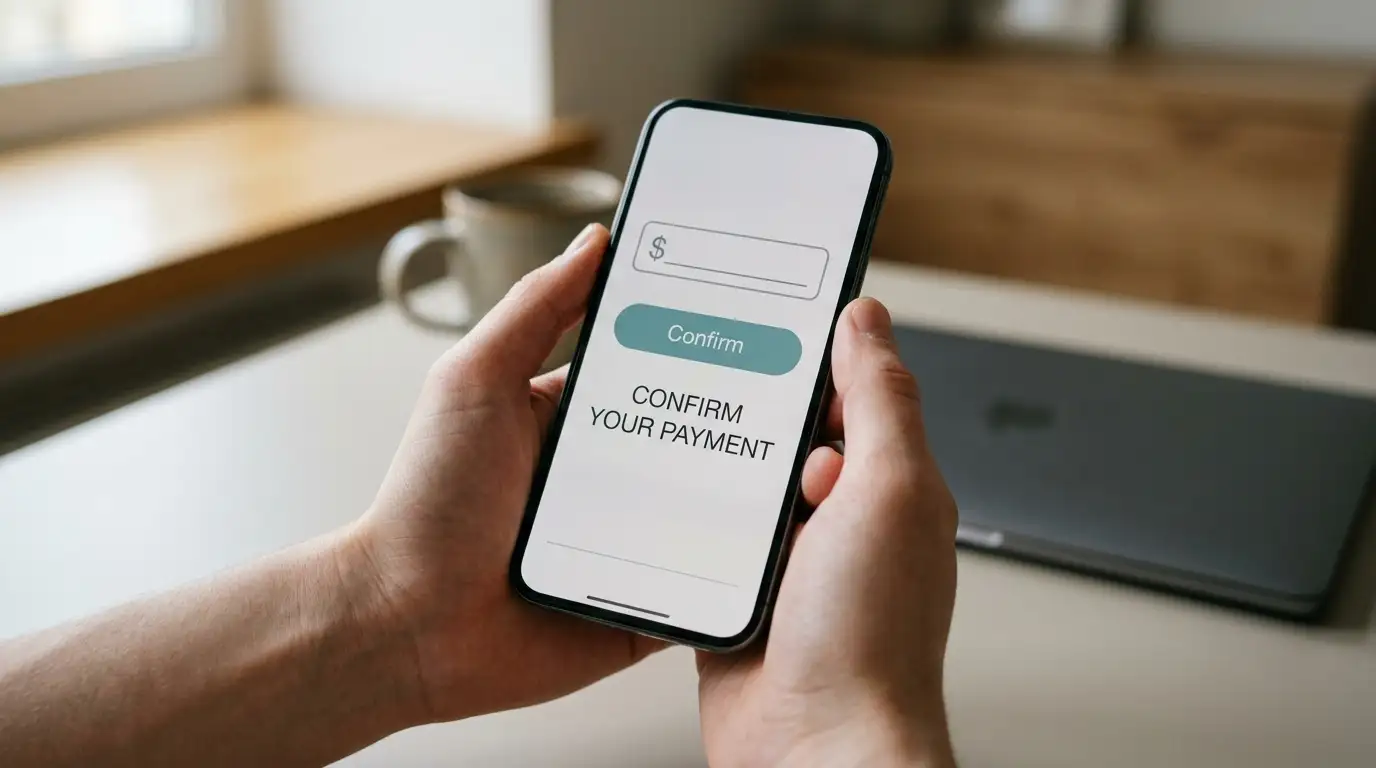
Depositing from the phone, which is where it actually happens
Mobile casino coverage usually means checking whether a site is responsive. For instant bank transfers that misses the point entirely, because the transaction does not happen on the casino’s site at all.
Look at the actual sequence. You are in the cashier, you take a temporary PayID and a reference number, and then you leave — switching to your banking app, authenticating with a fingerprint or a passcode, pasting an address, typing an amount, entering the reference, and approving a 2FA challenge that may arrive as an SMS you have to read from a notification while the banking app is in the foreground. Then back to the casino. That is three app contexts and two authentication steps on a five-inch screen, and it is where deposits actually go wrong: a reference number gets lost in a clipboard, or the 30-minute address window expires while someone hunts for a One Time Password.
Which makes the practical mobile advice unglamorous. Enrol your PayID and raise your daily limit at a desktop or during a calm moment, not while a cashier timer runs. Copy the reference before the address, since the address is what most apps validate first and the reference is what gets forgotten. And screenshot the confirmation, because on a phone that screenshot is the only record you will have if a manual match becomes necessary.
The banking app itself is the constraint, not the casino. Every operator on this page runs acceptably in a mobile browser and several offer a progressive web app, and the differences between them are cosmetic next to whether your bank’s app makes PayID sending easy or buries it three menus deep.
Keeping the speed from becoming the problem
Instant rails remove friction in both directions, and friction was doing quiet work.
An overnight clearing delay used to be an accidental cooling-off period. You decided to deposit, the money took until Tuesday, and by Tuesday the decision had been reconsidered a few times. The NPP has no such delay by design, and that is a genuine improvement for anyone paying a bill and a genuine hazard for anyone chasing a loss at 1am. Eight seconds is not enough time to change your mind, and it is not supposed to be.
Two structural facts follow. First, the limit uplift you raised for a single large deposit stays raised — there is no automatic reversion, and a A$20,000 ceiling set once is a A$20,000 ceiling permanently. Lower it back deliberately. Second, and this is the one that matters most: BetStop does not reach any operator on this page. Australia’s self-exclusion register binds licensed wagering services and has no jurisdiction over offshore casinos, so the register that would stop you at a licensed bookmaker will not stop you here.
That leaves bank-side controls as the only brake that actually functions. Your bank’s gambling block, set on your own account, is enforceable in a way no offshore operator’s responsible-gambling page is — and a daily PayID limit set to match a bankroll plan rather than a session mood is the most effective tool available to an Australian playing offshore. Set the limits when you are calm, because the whole design of the system now assumes you will be sending money at a moment when you are not.
Free, confidential support is available around the clock through Gambling Help Online on 1800 858 858. Play only if you are 18 or over.
Casino Deposit Methods Australia 2026 — Compared
Content created by the «PokiePay» team